A life in context
The person behind the prize
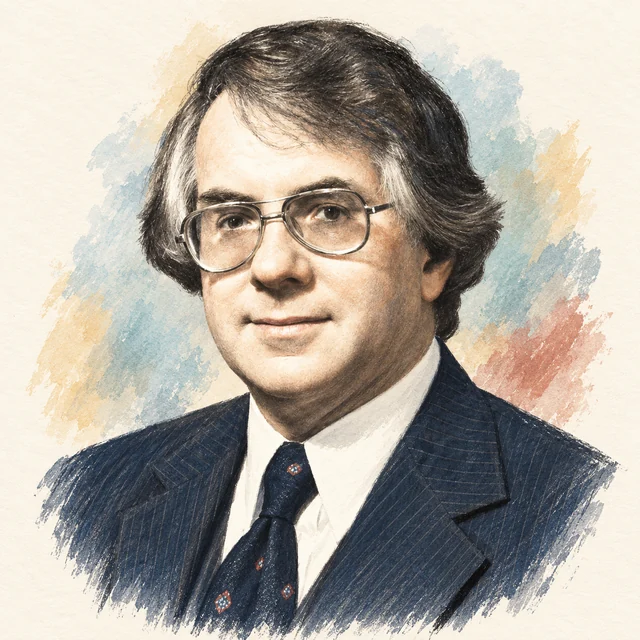
Glashow grew up in New York and attended the Bronx High School of Science, where Steven Weinberg was a classmate. After Cornell, he studied at Harvard with Julian Schwinger, pursuing the idea that weak and electromagnetic interactions should be described together. Research in Copenhagen helped him develop a model published in 1961 with both charged and neutral weak carriers. Its treatment of particle masses remained incomplete. He worked at several American universities before joining Harvard in 1966. Later collaboration with John Iliopoulos and Luciano Maiani linked weak interactions with the proposed charm quark. The electroweak theory emerged through separate contributions, corrections and experimental tests rather than a single finished proposal.
The contribution
Glashow developed an early electroweak gauge model with a neutral weak interaction alongside the charged one. He received one third of the Physics Prize; Salam and Weinberg received the other thirds. His initial model needed subsequent symmetry-breaking and quantum-theory developments.
The idea in plain language
Electromagnetism has a massless carrier, the photon, while weak interactions have massive carriers and a much shorter range. Glashow’s early gauge model included both charged and neutral weak interactions. Weinberg and Salam independently incorporated spontaneous symmetry breaking, which allows the weak carriers to have mass while the photon remains massless. A shared underlying framework can therefore produce quite different observed behaviour.
Read the full award story ↗