A life in context
The person behind the prize
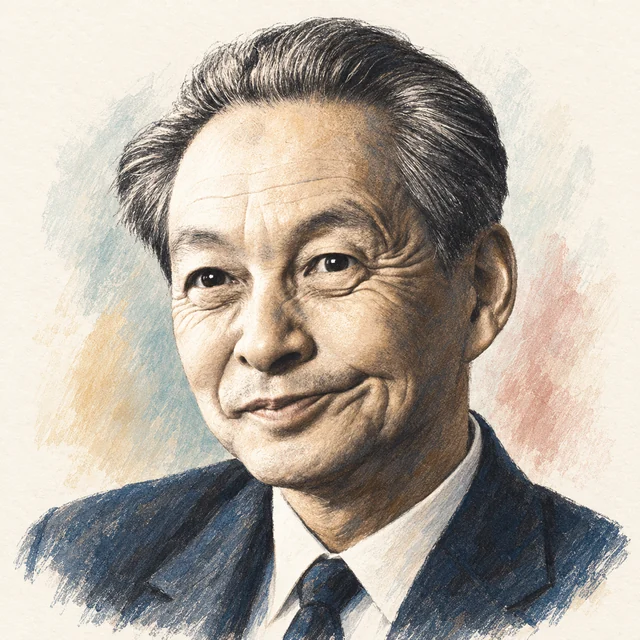
Tomonaga was born in Tokyo and moved with his family to Kyoto in 1913. He graduated in physics at Kyoto in 1929 and joined Nishina’s RIKEN laboratory in 1932. Work with Heisenberg’s group in Leipzig from 1937 to 1939 contributed to his doctorate, awarded by Tokyo Imperial University in 1939. He became professor at Tokyo Bunrika University in 1941. His work on a relativistically covariant formulation began during the war: a Japanese paper appeared in 1943, followed by an English translation in 1946. After the war, he and collaborators developed renormalized quantum electrodynamics, linking the theory with measured electron properties and the Lamb shift. He also studied many-body systems and led scientific institutions. The 1965 affiliation was Tokyo University of Education, whose later reorganisation as Tsukuba belongs to subsequent history.
The contribution
Tomonaga developed a relativistically covariant formulation and renormalization methods for quantum electrodynamics. He received one third of the Physics Prize.
The idea in plain language
Quantum electrodynamics combined quantum theory with relativity, but early calculations of corrections to electron properties produced troublesome infinities. Experiments such as the Lamb shift and measurements of the electron’s magnetic moment demanded a workable theory.
Read the full award story ↗