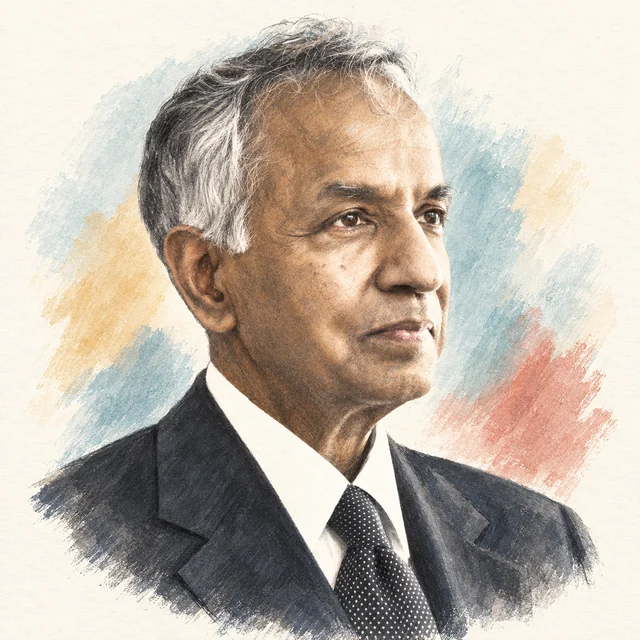
A life in context
The person behind the prize
Educated first at home and then in Madras, Chandrasekhar completed his physics degree at Presidency College in 1930. A scholarship took him to Cambridge, where R. H. Fowler supervised his doctorate, completed in 1933. This Fowler was a different scientist from his 1983 co-laureate William A. Fowler. Chandrasekhar joined Chicago in January 1937. His research ranged from stellar interiors and dynamics to radiation, fluid stability and black holes. He developed the white-dwarf mass limit early in his career; his 1983 black-hole monograph reflects his much broader programme. He credited the support of his wife Lalitha, whom he married in 1936.
The contribution
Chandrasekhar combined quantum physics, relativity and mathematical analysis to explain stellar structure and evolution. His white-dwarf result showed that electron degeneracy pressure has a mass limit. It concerns a stellar remnant, not a universal threshold for the initial mass of any star. He received one half of the Physics Prize; William A. Fowler’s nuclear-reaction research supplied a distinct contribution.
The idea in plain language
Gravity pulls stellar matter inward. Pressure can resist it, but the source of that pressure changes as a star evolves. Chandrasekhar studied these balances mathematically. In an idealised cold, nonrotating white dwarf, quantum electron degeneracy pressure has a limiting mass of roughly 1.4 Suns for common compositions. Including relativity is essential to this result.
Read the full award story ↗