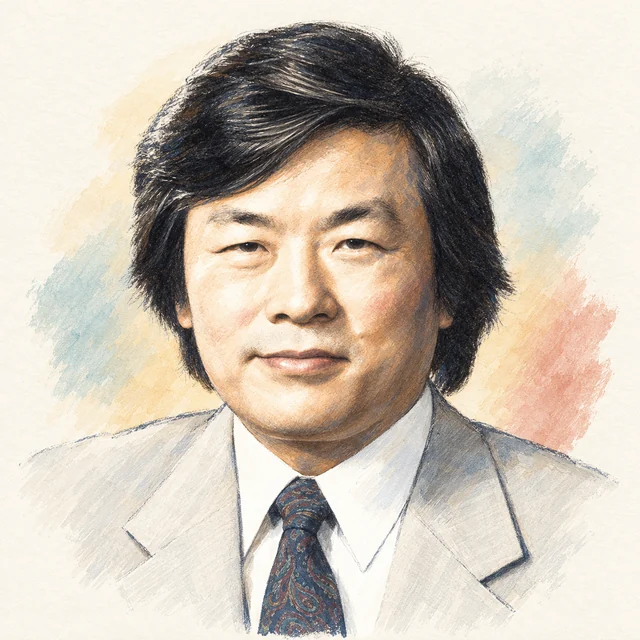
A life in context
The person behind the prize
Tonegawa entered Kyoto University in 1959 and moved from chemistry toward molecular biology. He trained with Masaki Hayashi at the University of California, San Diego, completing his doctorate in 1968, then worked with Renato Dulbecco at the Salk Institute. A move to the Basel Institute for Immunology in 1971 introduced a new research problem and supportive colleagues. DNA analysis with Nobumichi Hozumi and others showed how antibody genes change during immune-cell development. He joined MIT in 1981 and continued work on gene regulation and immune receptors.
The contribution
Tonegawa established that antibody diversity depends on somatic rearrangement of DNA segments, resolving a conflict between many possible antibodies and a limited inherited gene repertoire. In a 1976 paper with Hozumi, mouse embryonic DNA and an antibody-producing tumour’s DNA gave different arrangements of light-chain variable and constant gene sequences. Later work clarified mechanisms and additional diversity. He received the full Medicine Prize; this is development of particular immune cells, not rewriting the inherited genome throughout the body.
The idea in plain language
An inherited genome need not contain a separate complete gene for every possible antibody. Tonegawa’s work showed that developing B cells rearrange gene segments to assemble antibody genes. Heavy chains use V, D and J segments; light chains use V and J. Joining differences, heavy–light pairing and later somatic mutation add diversity.
Read the full award story ↗

