A life in context
The person behind the prize
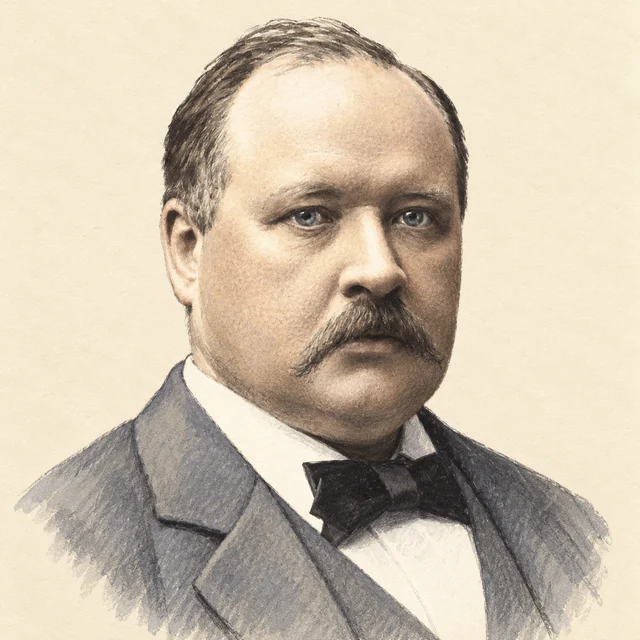
Svante Arrhenius grew up near Uppsala and entered its university in 1876. In 1881 he began work with Erik Edlund at the Academy of Sciences in Stockholm. His 1884 dissertation proposed that dissolved electrolytes contain electrically charged particles, or ions, even before an electric current is applied. The proposal initially met resistance, but contacts with Wilhelm Ostwald, Friedrich Kohlrausch, Ludwig Boltzmann and Jacobus van ’t Hoff helped connect his work with the developing field of physical chemistry. He became a lecturer at Stockholm University College in 1891, professor in 1895 and rector from 1897 to 1905. The dissociation theory offered a common explanation for electrical conduction and several properties of solutions. Dissolved salt could contribute separate positive and negative ions; those charged particles could move under an electric field. Applied current therefore did not have to create all the carriers whose movement it revealed. The theory also connected with the number of dissolved particles inferred from solution behaviour. Its original formulation had limits, especially for concentrated solutions and interactions among ions; later physical chemistry refined the picture. It does not imply that every dissolved substance forms ions: sugar solutions provide an important contrasting case. Arrhenius received the full 1903 Chemistry Prize for the theory of electrolytic dissociation. His work on reaction rates and his 1896 calculations concerning carbon dioxide and climate were other contributions, rather than the citation for this award. From 1905 he directed the Nobel Institute for Physical Chemistry. His public influence also had a harmful dimension: Uppsala University records his membership on the board of the Swedish Society for Racial Hygiene and his advocacy for a state institute of racial biology, founded in 1922. These commitments belong in an account of his career and should not be excused by scientific achievement. Arrhenius died in Stockholm in 1927. His story joins an influential explanatory idea with the need to examine critically how scientific authority is used in society.
The contribution
Arrhenius explained electrolyte solutions through dissociation into ions, making charged particles central to conduction and solution properties. His full Chemistry Prize was for this theory, rather than his separate climate or reaction-rate work.
The idea in plain language
Arrhenius proposed that an electrolyte can separate into positively and negatively charged ions in solution. Those ions can exist before an electric current is applied. Under an electric field their movement carries charge; the current does not first have to create every carrier.
Read the full award story ↗

