A life in context
The person behind the prize
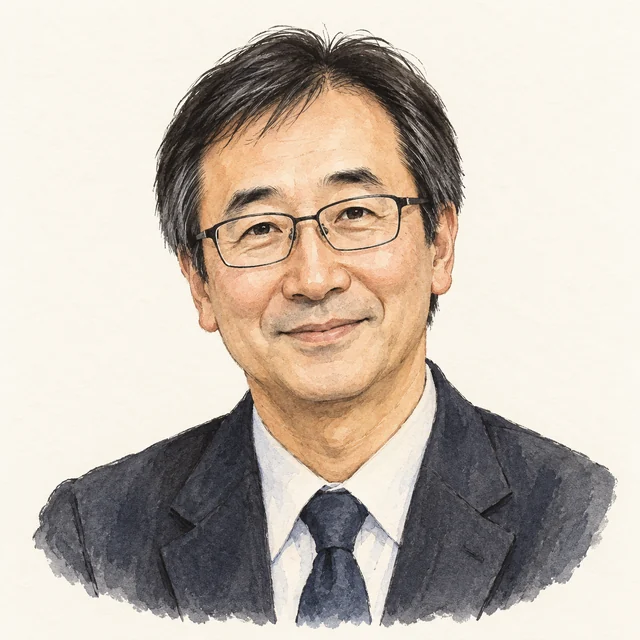
Kajita studied at Saitama University and completed his doctorate at the University of Tokyo in 1986 under Masatoshi Koshiba. His research grew out of work with large underground particle detectors. At Super-Kamiokande, he helped turn rare flashes of light in an enormous water tank into evidence about particles arriving from the atmosphere. The discovery depended on a large collaboration and careful comparisons of signals from different directions.
The contribution
In 1998 he presented evidence that atmospheric muon neutrinos changed type during travel. Neutrinos arriving after a long journey through Earth showed a different pattern from those travelling a shorter distance from above. Oscillations require differences between neutrino masses, revealing physics beyond the original massless-neutrino picture.
The idea in plain language
Neutrinos are tiny particles that rarely interact with matter. They come in three detectable types, called flavours: electron, muon and tau. For decades, experiments counted fewer electron neutrinos from the Sun than calculations predicted. Was the model of the Sun wrong, or were the experiments missing something about the particles? A detector sensitive mainly to one flavour could not settle the question by itself.
Read the full award story ↗