01 · The discovery
The idea, in everyday language
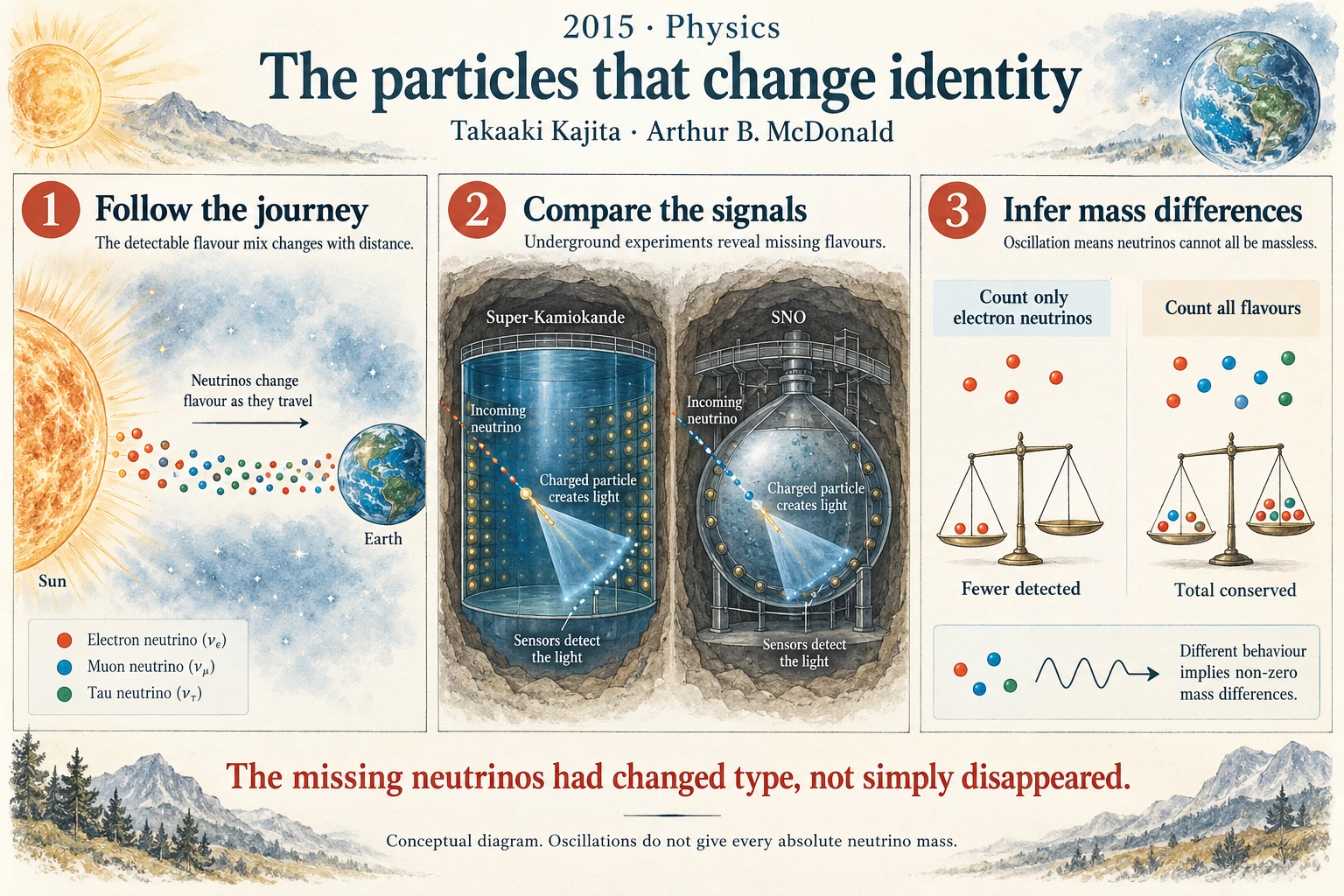
Neutrinos are tiny particles that rarely interact with matter. They come in three detectable types, called flavours: electron, muon and tau. For decades, experiments counted fewer electron neutrinos from the Sun than calculations predicted. Was the model of the Sun wrong, or were the experiments missing something about the particles? A detector sensitive mainly to one flavour could not settle the question by itself.
Two large collaborations found complementary answers. At Super-Kamiokande, Kajita and colleagues compared atmospheric neutrinos travelling different distances. Their 1998 results showed a shortage of muon neutrinos after the longer journey through Earth. At the Sudbury Neutrino Observatory, McDonald’s team used heavy water to compare electron-neutrino signals with measurements sensitive to other flavours too. Results beginning in 2001 showed that solar neutrinos were changing flavour, rather than simply vanishing. This quantum process is called neutrino oscillation.
Why it matters
Oscillations require differences between neutrino masses. That finding showed that the original Standard Model, which treated neutrinos as massless, needed extending. It also gave researchers a new way to investigate fundamental particles and interpret messengers arriving from the Sun, atmosphere and more distant sources.