c.curionodeThe Nobel Archive

2014 · Physics

The missing blue that changed everyday light

Efficient blue LEDs made a new generation of white lighting possible.

blue LEDsgallium nitrideefficient lighting
2014Physics

Visual guide

The prize, pictured

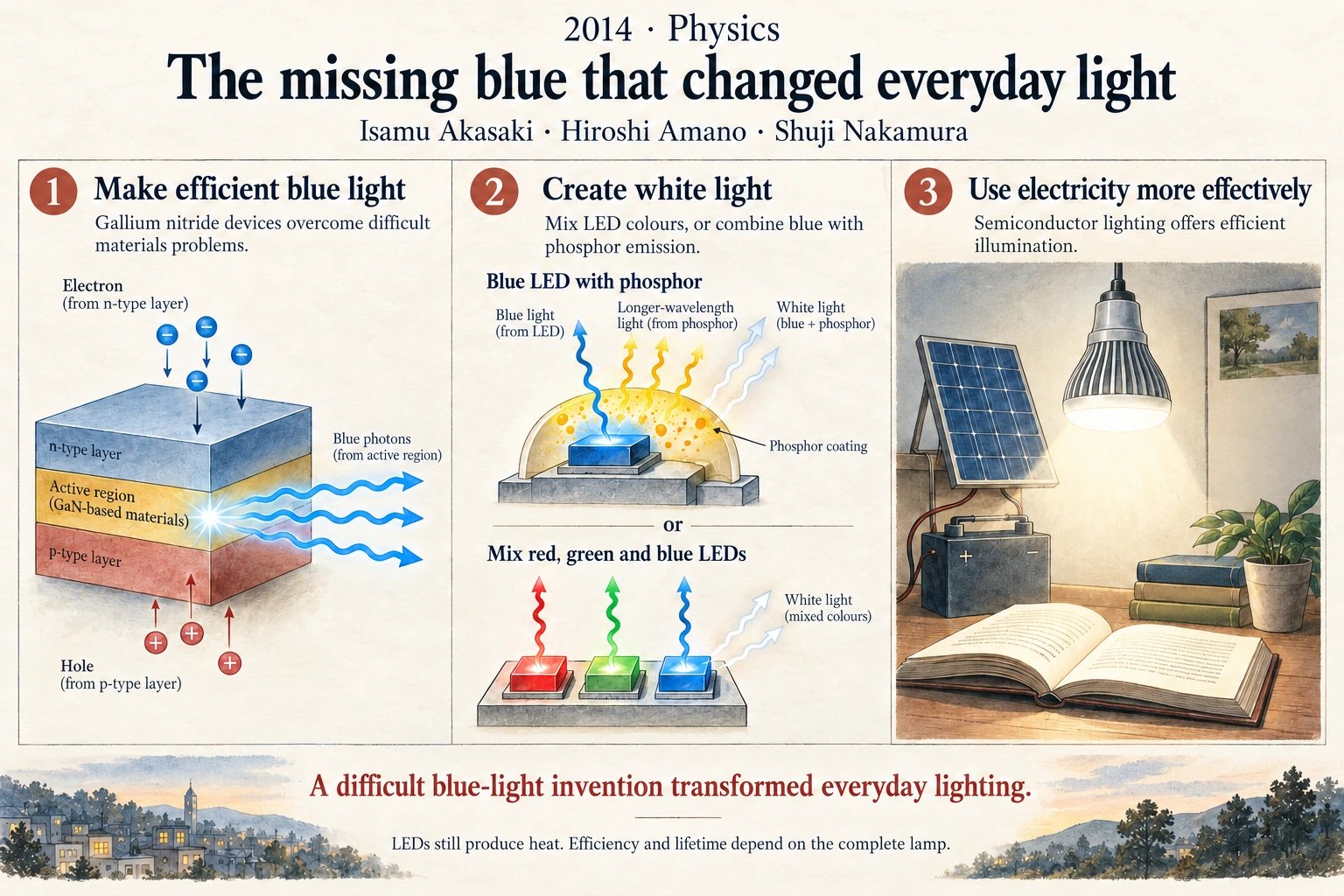
Infographic explaining The missing blue that changed everyday light
Original AI-generated infographic. A conceptual overview; the explanations and sources below provide context.
Read the poster text

A difficult blue-light invention transformed everyday lighting.

  1. Make efficient blue light

    Gallium nitride devices overcome difficult materials problems.

  2. Create white light

    Mix LED colours, or combine blue with phosphor emission.

  3. Use electricity more effectively

    Semiconductor lighting offers efficient illumination.

LEDs still produce heat. Efficiency and lifetime depend on the complete lamp.

01 · The discovery

The idea, in everyday language

An LED converts electrical energy into light inside a semiconductor. Electrons and positively charged vacancies, called holes, meet in an active region; some of their energy is released as photons. The material determines the photon energies and therefore the colour. Red and green LEDs existed long before efficient blue ones. Blue photons require a larger energy gap, and the suitable materials were much harder to turn into reliable devices.

Akasaki and Amano persisted with gallium nitride, improving its crystal quality with a buffer layer and finding a way to activate p-type material. Nakamura independently developed different growth and heat-treatment methods, then improved the emitting structures. These advances helped make bright blue LEDs practical. White light could then be produced by combining different LED colours, or by using blue light to excite a phosphor and mixing its longer-wavelength emission with some remaining blue.

Why it matters

The invention changed lighting and display technology. Efficient white LEDs can provide useful illumination with less electrical input than incandescent lamps, while compact devices allow new designs and low-power systems. The achievement joined materials science, device physics and persistent manufacturing experiments.
02 · The people

Who brought the idea to life?

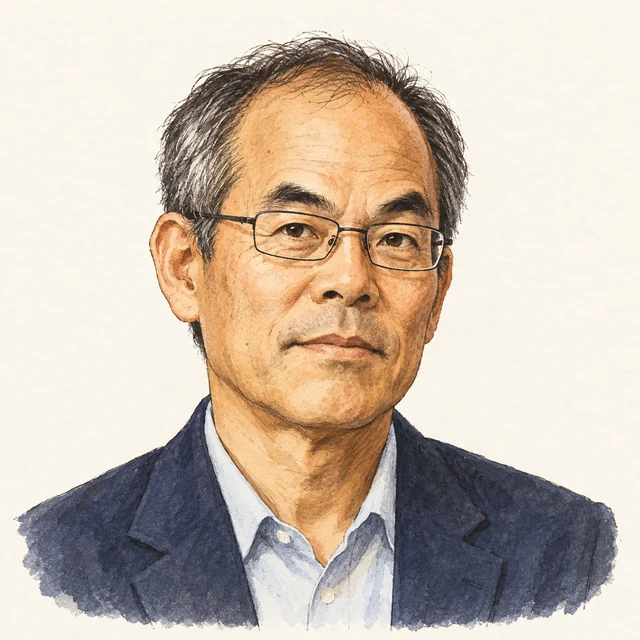
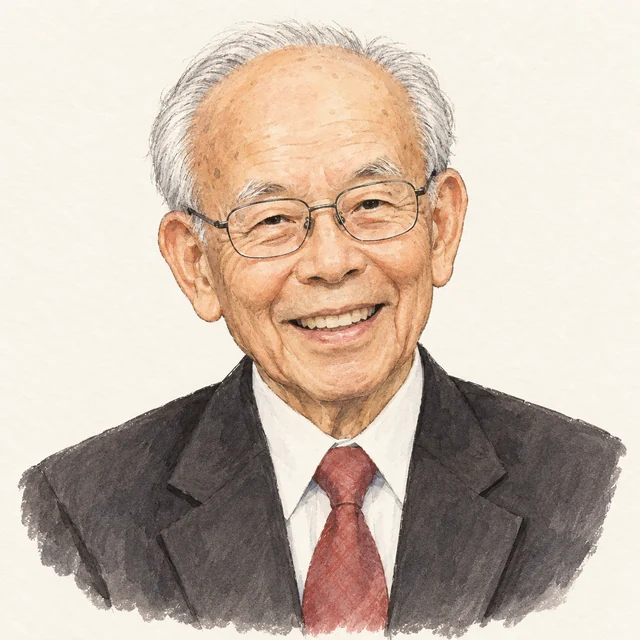
Illustrated portrait of Isamu Akasaki

Isamu Akasaki

Prize share · 1/3

Akasaki and Amano developed ways to grow high-quality gallium nitride and obtain a functioning p-type layer. These advances helped overcome two major obstacles to efficient blue LEDs. Their work, alongside Nakamura’s independent developments, enabled practical white-light sources based on semiconductor devices.

Read the biography ↗
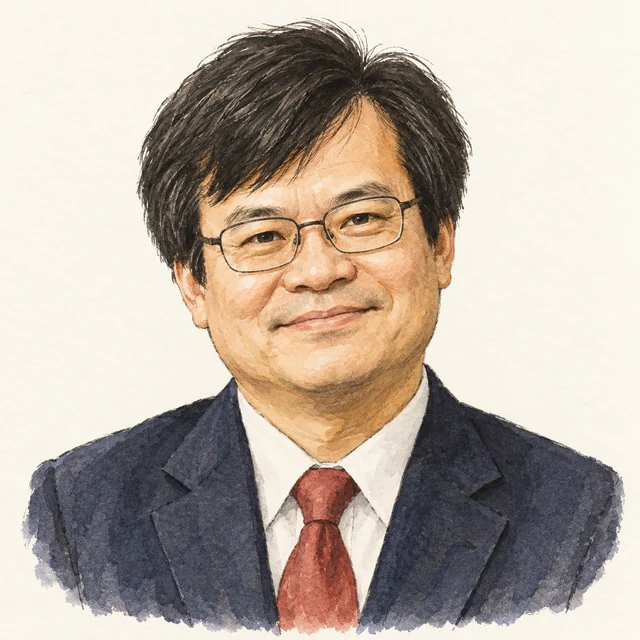
Illustrated portrait of Hiroshi Amano

Hiroshi Amano

Prize share · 1/3

He helped establish the use of an aluminium nitride buffer layer to grow better gallium nitride on sapphire. He and Akasaki also found that electron-beam treatment could activate p-type material. Together these results helped turn a promising but troublesome semiconductor into a route to blue LEDs.

Read the biography ↗
Illustrated portrait of Shuji Nakamura

Shuji Nakamura

Prize share · 1/3

Working independently of Akasaki and Amano’s group, he developed crystal-growth methods and heat treatment that made p-type gallium nitride practical. Further work on gallium-nitride-based alloys and device structures produced bright, efficient blue LEDs. Blue emission then became a crucial ingredient in white LED lighting.

Read the biography ↗

03 · Years in the making

The path here

  1. 1986

    Akasaki and Amano report improved gallium nitride crystal growth using a buffer layer.

  2. 1992

    Advances in p-type material and blue devices help make efficient emission practical.

  3. 2014

    The Physics Prize recognises the invention of efficient blue LEDs.

04 · Read further

From the original sources

Original explanations by Curionode, based on the official records below. Biographical details and affiliations refer to the award year.

  1. Official award announcement nobelprize.org
  2. Nobel Committee’s accessible background nobelprize.org