c.curionodeThe Nobel Archive

2013 · Physics

A field that helps explain elementary-particle mass

A theoretical mechanism proposed in 1964 gained experimental support through the discovery of the Higgs boson.

Higgs fieldelementary particlessymmetry
2013Physics

Visual guide

The prize, pictured

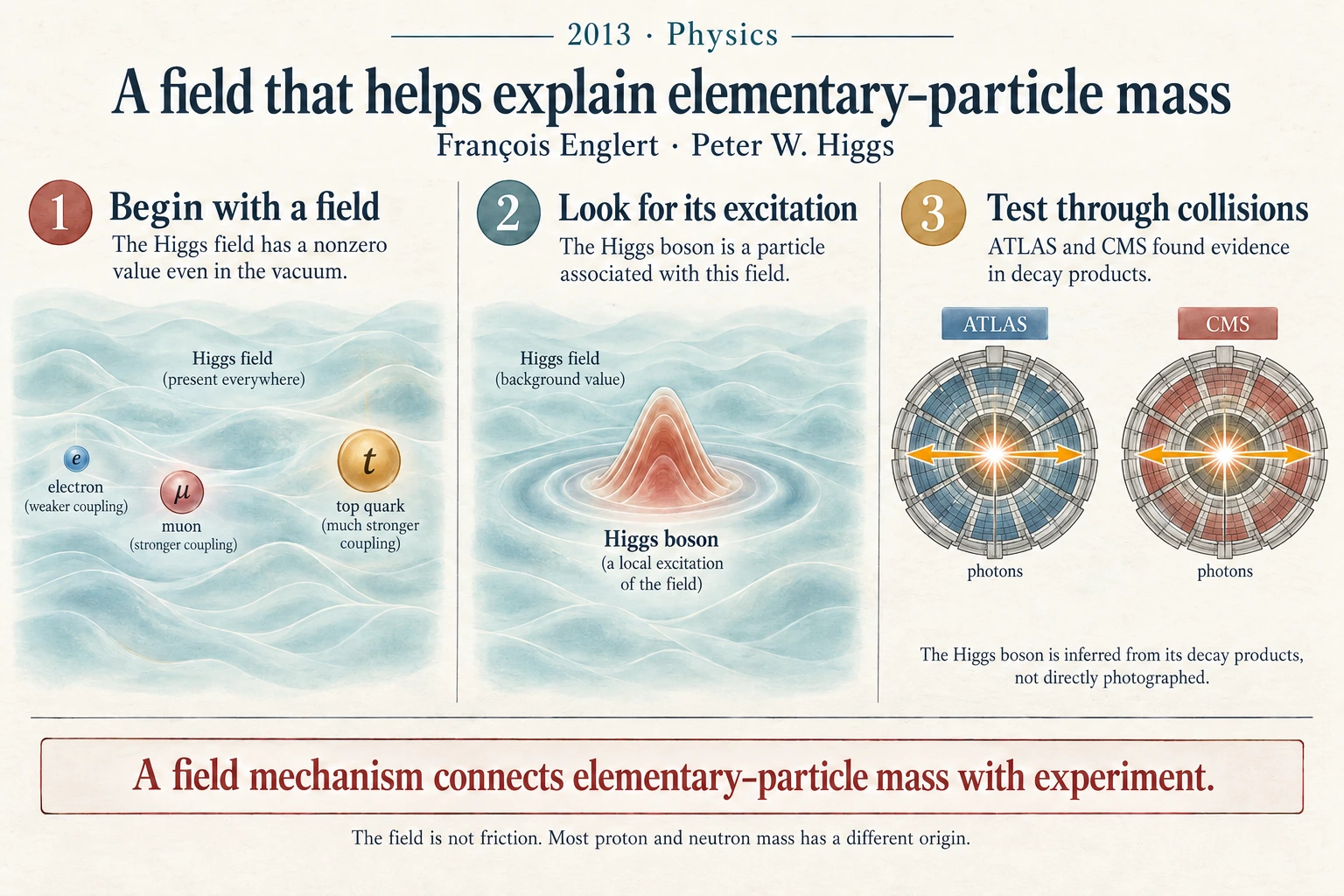
Infographic explaining A field that helps explain elementary-particle mass
Original AI-generated infographic. A conceptual overview; the explanations and sources below provide context.
Read the poster text

A field mechanism connects elementary-particle mass with experiment.

  1. Begin with a field

    The Higgs field has a nonzero value even in the vacuum.

  2. Look for its excitation

    The Higgs boson is a particle associated with this field.

  3. Test through collisions

    ATLAS and CMS found evidence in decay products.

The field is not friction. Most proton and neutron mass has a different origin.

01 · The discovery

The idea, in everyday language

The equations describing fundamental forces rely on symmetries: relationships that remain unchanged when the mathematical description is transformed. Simply inserting masses for the weak force’s carriers creates problems. Englert and Robert Brout, and independently Higgs, showed a way forward. A field can have a nonzero value even in its lowest-energy state, the vacuum. Its interaction with other fields allows massive particles to appear without abandoning the theory’s underlying structure.

In the Standard Model, this mechanism accounts for the masses of the W and Z bosons; related interactions with the Higgs field give charged elementary matter particles their masses. The field also has an observable excitation, the Higgs boson. ATLAS and CMS searched for the products of its short-lived decays in many proton collisions at CERN’s Large Hadron Collider. On 4 July 2012 they announced a new boson; subsequent measurements supported its identification as a Higgs particle. The prize honoured the theoretical mechanism, with explicit recognition of the experimental discovery that tested it.

Why it matters

The result connected a mathematical solution with measurable evidence and completed a long-missing part of the Standard Model. It gave experiments a new object whose interactions could be studied to test the theory more closely. This was the work of a large international research community, building on theoretical and experimental developments over decades.


02 · The people

Who brought the idea to life?

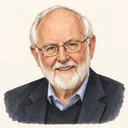
Illustrated portrait of François Englert

François Englert

Prize share · 1/2

In 1964, Englert and Brout showed how a field with a nonzero value in the vacuum could allow force-carrying particles to have mass while preserving the underlying structure of a gauge theory. This work, developed independently of Higgs, helped establish the mechanism later built into the electroweak theory. Brout died in 2011 and was not a recipient of the 2013 prize.

Read the biography ↗
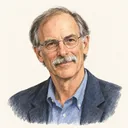
Illustrated portrait of Peter W. Higgs

Peter W. Higgs

Prize share · 1/2

His 1964 papers independently developed the mass-generating mechanism and drew attention to a surviving scalar particle, an excitation of the new field. Finding that particle became a crucial experimental test. The ATLAS and CMS collaborations announced a new boson in 2012 whose properties supported the Higgs interpretation, providing evidence for the mechanism recognised by the prize.

Read the biography ↗

03 · Years in the making

The path here

  1. 1964

    Englert and Brout, and independently Higgs, develop the mass-generating mechanism.

  2. 2012

    ATLAS and CMS announce the discovery of a new boson at CERN.

  3. 2013

    The prize recognises Englert and Higgs for the theoretical mechanism, now supported by experiment.

04 · Read further

From the original sources

Original explanations by Curionode, based on the official records below. Biographical details and affiliations refer to the award year.

  1. Official announcement nobelprize.org
  2. Popular science background nobelprize.org
  3. CERN: the Higgs boson home.cern
  4. CERN: the other 99% home.cern