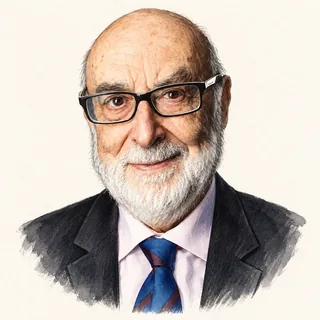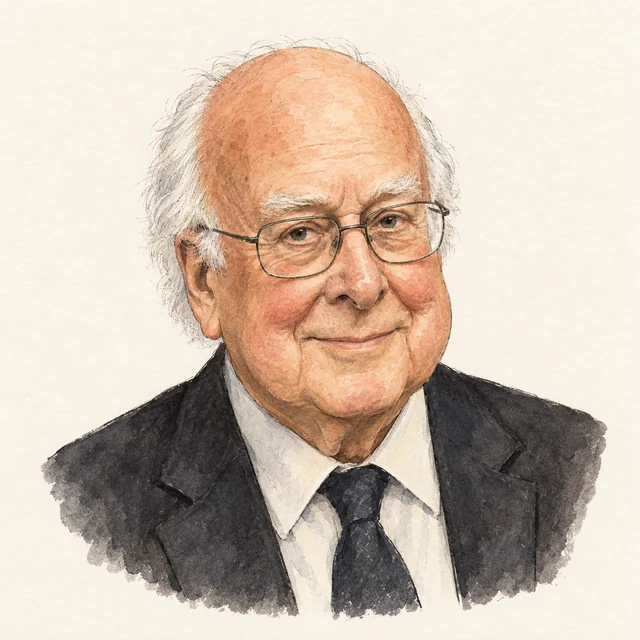
A life in context
The person behind the prize
Higgs grew up in Britain, with asthma interrupting parts of his early schooling. He studied at King’s College London and completed his doctorate in 1954. Much of his research career was based at the University of Edinburgh. His work addressed a theoretical obstacle: how to describe massive force-carrying particles without losing the mathematical consistency that made the theory useful. He lived to see an experimental test that had taken almost half a century to achieve.
The contribution
His 1964 papers independently developed the mass-generating mechanism and drew attention to a surviving scalar particle, an excitation of the new field. Finding that particle became a crucial experimental test. The ATLAS and CMS collaborations announced a new boson in 2012 whose properties supported the Higgs interpretation, providing evidence for the mechanism recognised by the prize.
The idea in plain language
The equations describing fundamental forces rely on symmetries: relationships that remain unchanged when the mathematical description is transformed. Simply inserting masses for the weak force’s carriers creates problems. Englert and Robert Brout, and independently Higgs, showed a way forward. A field can have a nonzero value even in its lowest-energy state, the vacuum. Its interaction with other fields allows massive particles to appear without abandoning the theory’s underlying structure.
Read the full award story ↗