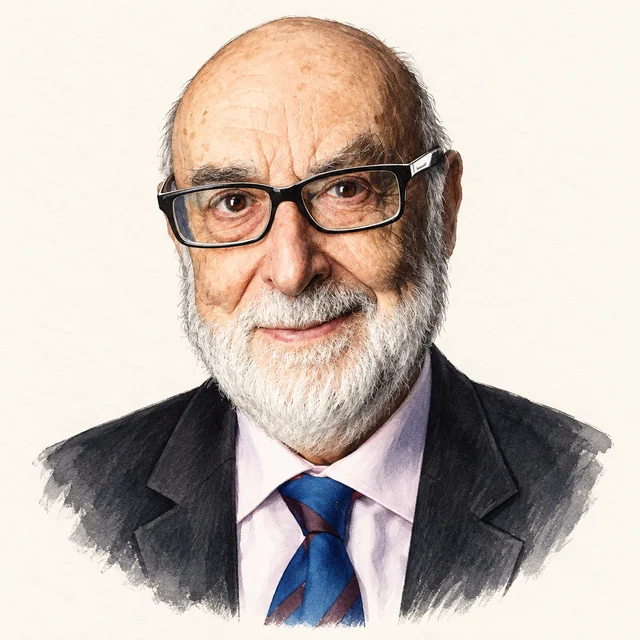
A life in context
The person behind the prize
Englert survived the Nazi occupation of Belgium as a Jewish child in hiding. He first trained as an electrical-mechanical engineer, then earned a physics doctorate at the Université Libre de Bruxelles in 1959. After research at Cornell University, he returned to Brussels. His collaboration with Robert Brout brought ideas about collective behaviour and symmetry into the study of fundamental particles, connecting apparently abstract mathematics with a central problem in particle physics.
The contribution
In 1964, Englert and Brout showed how a field with a nonzero value in the vacuum could allow force-carrying particles to have mass while preserving the underlying structure of a gauge theory. This work, developed independently of Higgs, helped establish the mechanism later built into the electroweak theory. Brout died in 2011 and was not a recipient of the 2013 prize.
The idea in plain language
The equations describing fundamental forces rely on symmetries: relationships that remain unchanged when the mathematical description is transformed. Simply inserting masses for the weak force’s carriers creates problems. Englert and Robert Brout, and independently Higgs, showed a way forward. A field can have a nonzero value even in its lowest-energy state, the vacuum. Its interaction with other fields allows massive particles to appear without abandoning the theory’s underlying structure.
Read the full award story ↗