A life in context
The person behind the prize
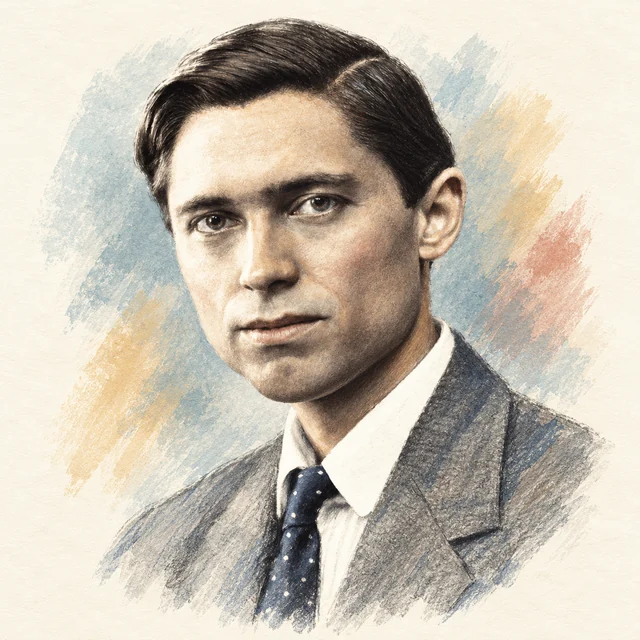
Svedberg grew up in Sweden with interests in both natural science and painting. The name The is a shortened form of Theodor. He entered Uppsala University in 1904, completed his doctorate in 1908 and became professor of physical chemistry in 1912. His research concerned disperse systems: small particles or large molecules distributed through another material. Studies of diffusion, Brownian motion and fluctuations connected observable particles with molecular theory. He also developed methods for making colloidal preparations and trained an international research group. In 1925 he developed the ultracentrifuge, allowing the distribution of material in rapidly rotating solutions to be measured. Such measurements helped investigate molecular masses and the uniformity of particular protein preparations. They did not mean that all proteins have the same mass or that sedimentation depends on mass alone. Svedberg received the full 1926 Chemistry Prize for work on disperse systems. After becoming emeritus in 1949 he remained active in research, including nuclear chemistry, and died in 1971.
The contribution
Svedberg received the full Chemistry Prize for work on disperse systems. His colloid studies and ultracentrifuge made sedimentation and molecular properties accessible to quantitative investigation.
The idea in plain language
In a disperse system, small particles or large molecules are distributed through another material. They may be too small to study by ordinary visual inspection. Svedberg investigated their diffusion, motion and concentration fluctuations, connecting colloid chemistry with the molecular picture of matter.
Read the full award story ↗

