A life in context
The person behind the prize
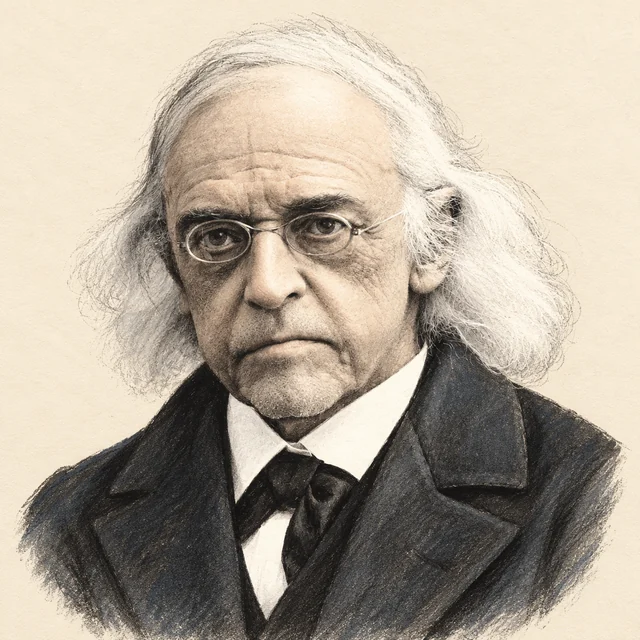
Theodor Mommsen was born at Garding in Schleswig, then under the Danish monarchy. He studied law and classical subjects at Kiel from 1838 to 1843, travelled in France and Italy and worked in journalism before entering university teaching. A law professorship at Leipzig began in 1848; political involvement led to dismissal in 1850. He later taught at Zürich and Breslau before taking the Berlin chair of ancient history in 1858. His scholarship joined legal analysis with inscriptions, coins, chronology and the organisation of large bodies of evidence. The Corpus Inscriptionum Latinarum became a major collaborative undertaking under his leadership, established as an academy project in 1853 and publishing its first volume in 1863. Its evidence provided resources for investigating Roman administration, society and institutions beyond the narratives of ancient authors. Mommsen’s own historical writing gave those materials force through interpretation and an energetic style. The first three volumes of A History of Rome appeared in 1854–1855 and treated the Roman Republic; a later volume on the imperial provinces appeared in 1885. A planned general history of the Empire remained unwritten, so the work should not be described as a completed history of every Roman period. The 1902 Literature Prize recognised the art of his historical exposition, with particular reference to this work. It was not a separate Nobel Prize in history. His judgments were passionate and shaped by nineteenth-century political commitments, including admiration for Caesar and hostility toward the senatorial oligarchy. His public politics also require a mixed account: he opposed antisemitism while expressing nationalist hostility toward Slavic peoples. Critical attention to those positions belongs alongside appreciation of his scholarship. He was absent from the Stockholm ceremony, with the German minister replying on his behalf at the banquet. Mommsen died at Charlottenburg in 1903. His career demonstrates how historical research can become literature through argument and presentation without ceasing to require scrutiny of evidence, perspective and power.
The contribution
Mommsen combined broad research on Rome with powerful historical prose. The Literature Prize singled out A History of Rome, while its vivid judgments and political perspective remain subjects for critical reading.
The idea in plain language
Research on law, inscriptions, coins and institutions supplied a broad evidential base. Large collaborative projects organised material that could be compared and used by other scholars. Such evidence did not speak for itself: choices about questions, emphasis and explanation remained necessary.
Read the full award story ↗

