A life in context
The person behind the prize
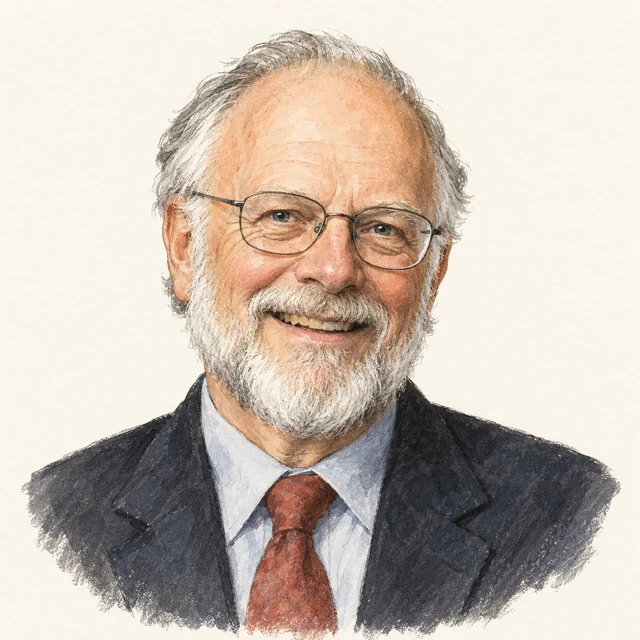
Steitz studied at Lawrence University and earned his doctorate at Harvard in 1966 under William Lipscomb. After postdoctoral work at the MRC Laboratory of Molecular Biology in Cambridge, he moved to Yale. He used X-ray crystallography to investigate how biological molecules work, tackling progressively complex structures and the challenge of turning diffraction measurements into an atomic model.
The contribution
Steitz’s group determined the structure of the ribosome’s large subunit, reaching atomic detail in 2000. This revealed the organisation of the region that joins amino acids into a protein chain and supported the central catalytic role of ribosomal RNA. Structures with bound molecules helped connect the architecture to chemical function and to the action of antibiotics.
The idea in plain language
A ribosome translates information carried by messenger RNA into a chain of amino acids. Transfer RNAs bring the building blocks and pair with the message, while the ribosome helps choose the right match and form the links. It is a large assembly of RNA and proteins with two interacting subunits. Knowing the broad outline was different from seeing how its working parts fit together.
Read the full award story ↗