01 · The discovery
The idea, in everyday language
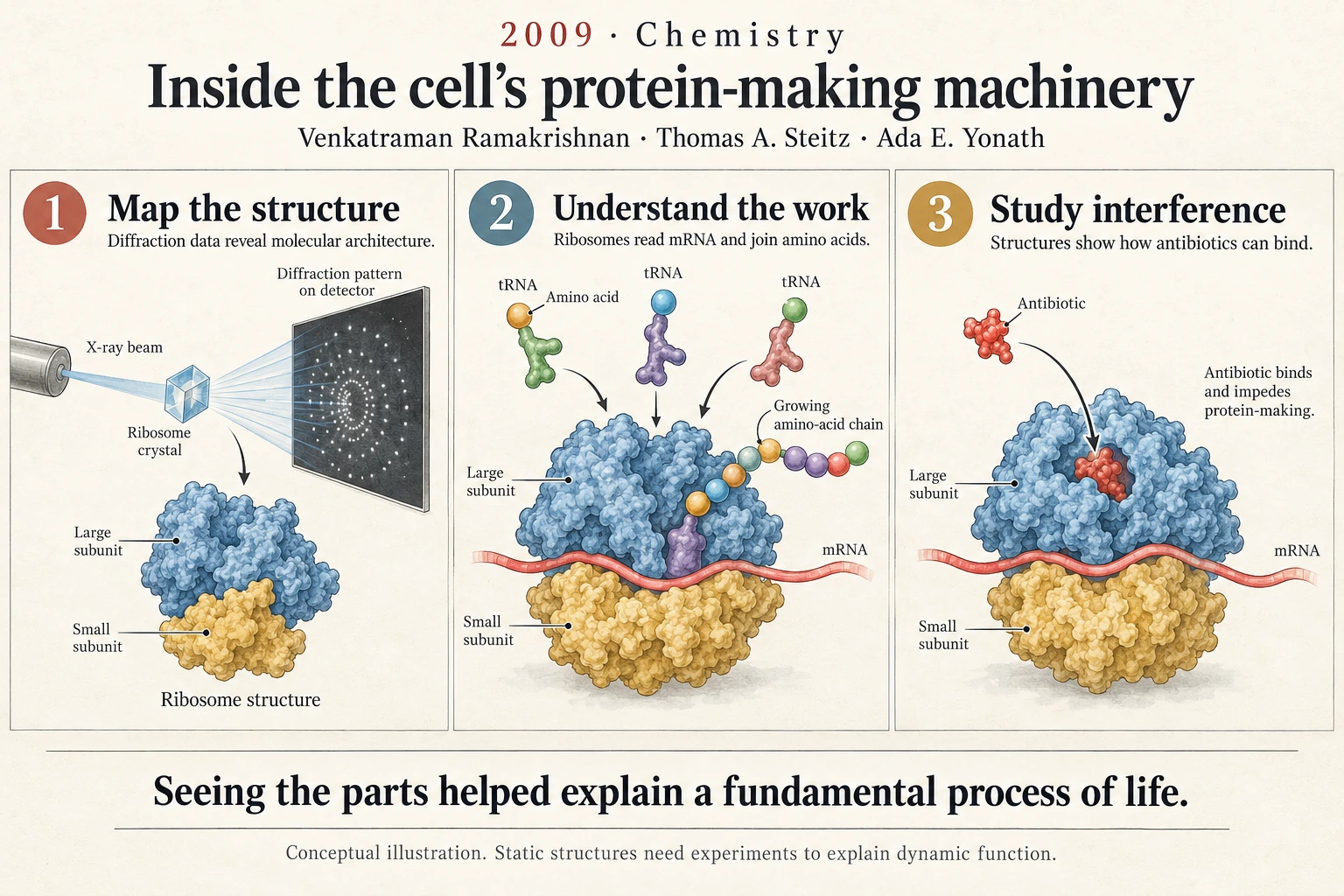
A ribosome translates information carried by messenger RNA into a chain of amino acids. Transfer RNAs bring the building blocks and pair with the message, while the ribosome helps choose the right match and form the links. It is a large assembly of RNA and proteins with two interacting subunits. Knowing the broad outline was different from seeing how its working parts fit together.
Yonath pioneered the difficult crystallisation work. Steitz and his team mapped the large subunit, including its catalytic centre; Ramakrishnan and Yonath’s groups determined high-resolution structures of the small subunit. Structures published in 2000 allowed researchers to interpret atomic positions and investigate decoding, peptide-bond formation and antibiotic binding. These models came from X-ray diffraction and analysis, not from looking through an ordinary microscope.
Why it matters
The work helped explain the accuracy of translation and the central role of ribosomal RNA in making peptide bonds. It also showed where many antibiotics bind and how they disrupt bacterial protein production. Structural information can guide drug research, alongside experiments on activity, resistance, delivery and safety.