01 · The discovery
The idea, in everyday language
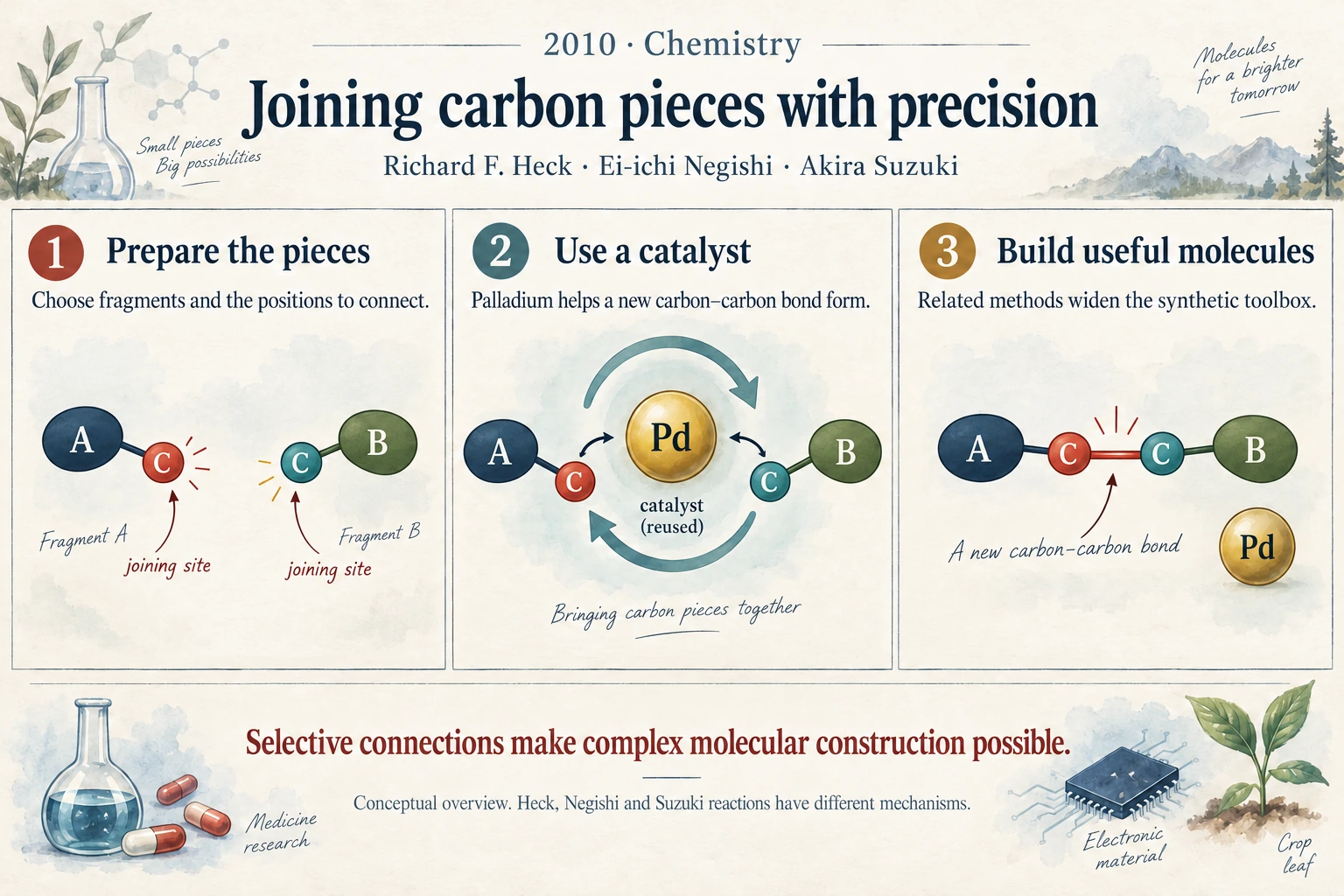
Many useful molecules have a skeleton of carbon atoms. Building a complicated one often means joining smaller fragments at chosen positions while leaving other features intact. A reaction that attacks everything indiscriminately can destroy the structure you are trying to make. Heck, Negishi and Suzuki developed powerful ways to form carbon–carbon bonds with the help of palladium catalysts.
The reaction partners and mechanisms differ. The Heck reaction commonly joins an organic fragment to an alkene; Negishi coupling uses an organozinc partner; Suzuki coupling uses an organoboron partner. Palladium participates in a sequence that enables the fragments to connect and is regenerated in the catalytic cycle. It is a working helper, not an extra carbon atom or a permanent metal bridge in the intended organic product.
Why it matters
Cross-coupling became a central tool in making medicines, crop-protection compounds, electronic materials and complex natural products. It lets chemists plan a large structure as smaller pieces that can be connected later. Synthesis also allows researchers to test and modify scarce natural molecules rather than relying only on extraction.