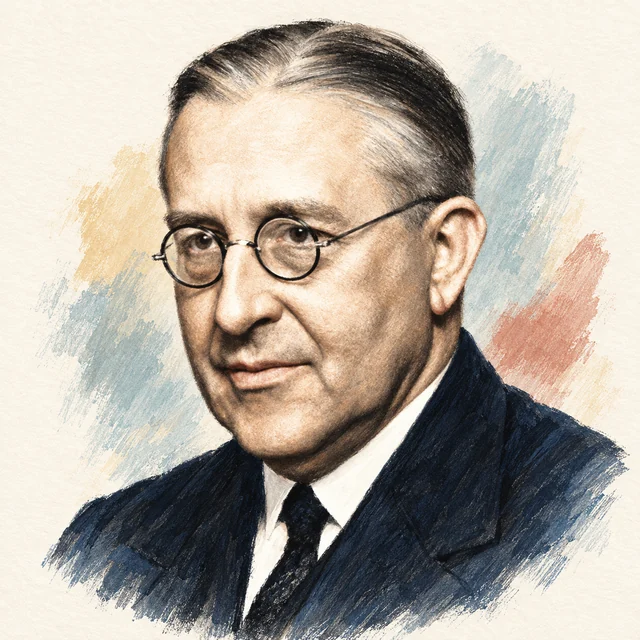
A life in context
The person behind the prize
Hess studied physics at Graz, earning his doctorate in 1906, and worked in Vienna, where he habilitated in 1910 and joined the new Institute for Radium Research. The unexplained loss of charge from insulated instruments led him to investigate radiation in the atmosphere. During balloon ascents in 1911–1912 he measured ionisation at increasing heights. Its marked rise above the lower atmosphere pointed to penetrating radiation arriving from outside Earth. After appointments at Graz and a period in the United States, he moved to Innsbruck in 1931 and established continuous observations at the Hafelekar mountain station. Innsbruck was his affiliation when he received half the 1936 Physics Prize. He returned to Graz in 1937. Dismissed under Nazi rule in 1938, he emigrated with his Jewish wife and took a professorship at Fordham in New York. Those later events are distinct from the discovery recognised by the prize.
The contribution
Hess received half the Physics Prize for discovering cosmic radiation. Carefully controlled balloon measurements showed that the penetrating radiation could not be explained by radioactive material in the ground alone.
The idea in plain language
Why did an insulated electrical instrument slowly lose its charge even when carefully shielded? Radiation could ionise the surrounding air and make it conductive, but radioactivity in the ground did not explain all the observations. Hess took improved instruments into balloons in 1911–1912. Ionisation first fell, then rose markedly at greater heights. Combined with night and eclipse observations, this supported radiation arriving from outside Earth, rather than a simple explanation based on the ground or ordinary sunlight.
Read the full award story ↗