A life in context
The person behind the prize
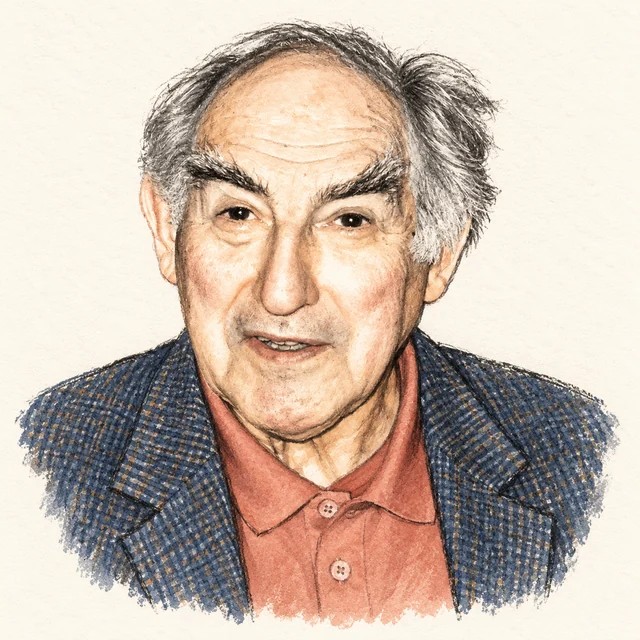
Ginzburg trained in physics at Moscow State University and completed his first research doctorate in 1940. That year he joined the Lebedev Physical Institute, where he developed a wide-ranging career in theoretical physics and astrophysics. His superconductivity work asked how a material’s collective quantum state responds to space, surfaces and magnetic fields, without requiring a detailed microscopic calculation for every electron.
The contribution
In 1950 Ginzburg and Lev Landau formulated a theory using an order parameter: a mathematical description of the local superconducting state. Coupling this quantity to the magnetic field made it possible to describe boundaries, characteristic length scales and critical fields. The framework also provided the starting point for Abrikosov’s vortex theory. It is a collective description, distinct from the later microscopic explanation of electron pairing.
The idea in plain language
At low temperatures, many particles can participate in a collective quantum state whose behaviour differs radically from that of ordinary matter. A superconductor can carry electrical current without resistance under suitable conditions. A superfluid can flow without the usual viscous resistance. The two phenomena are related, but electrical charge and the internal organisation of the particles make important differences.
Read the full award story ↗