01 · The discovery
The idea, in everyday language
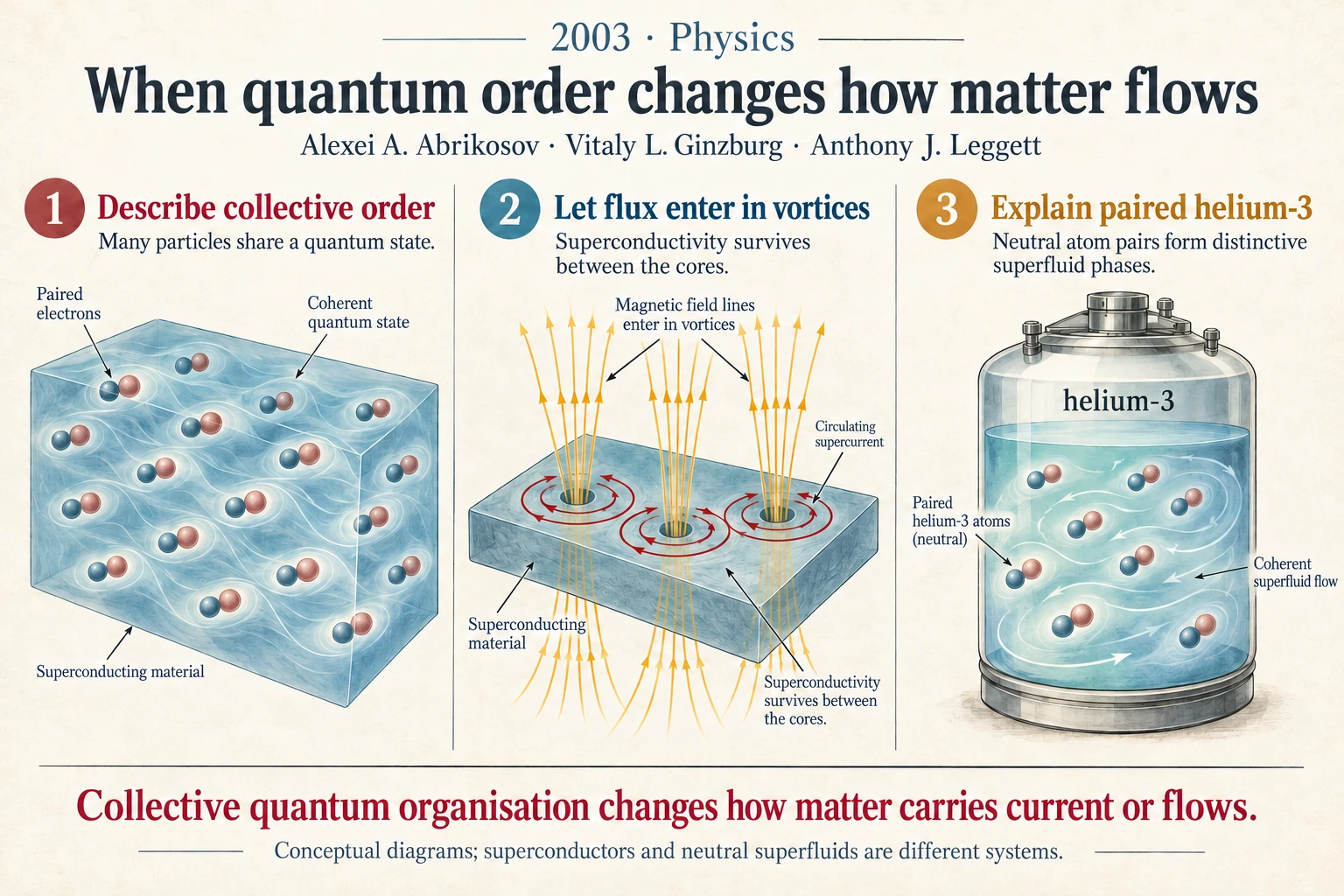
At low temperatures, many particles can participate in a collective quantum state whose behaviour differs radically from that of ordinary matter. A superconductor can carry electrical current without resistance under suitable conditions. A superfluid can flow without the usual viscous resistance. The two phenomena are related, but electrical charge and the internal organisation of the particles make important differences.
Ginzburg and Landau described superconductivity using an order parameter that can vary through a material. Abrikosov used this framework to explain how magnetic flux enters a type-II superconductor through vortices, leaving superconducting regions between them. Leggett addressed a different system: paired helium-3 atoms, whose spin and orbital organisation produces distinct superfluid phases. His theory helped make sense of the experimental signals from this unusual liquid.
Why it matters
The superconductivity theories provide tools for understanding materials used in powerful magnets, including many MRI and accelerator magnets. Superfluid helium-3 offers a laboratory for studying quantum order, symmetry and excitations. The common achievement was to connect collective mathematical descriptions with measurable behaviour in very different systems.