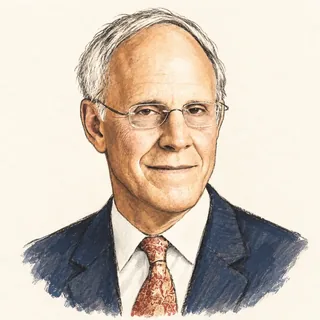
A life in context
The person behind the prize
Politzer was a graduate student at Harvard when he carried out the work recognised by the prize. He received his doctorate in 1974 and later built his research career at the California Institute of Technology. His early calculation addressed a central difficulty: ordinary approximation methods appeared unable to handle a force that was so strong inside familiar particles.
The contribution
In 1973 Politzer independently found that certain quantum gauge theories have an interaction strength that decreases at short distances. His paper appeared alongside the paper by Gross and Wilczek. The result gave physicists a controlled way to calculate high-energy processes involving quarks and gluons; it did not mean that isolated quarks could be collected as ordinary free particles.
The idea in plain language
Protons and neutrons contain quarks interacting through gluons. The force is strong enough that isolated quarks are not observed in ordinary experiments. Yet high-energy scattering revealed behaviour resembling collisions with nearly free constituents. A useful theory had to account for both the binding of matter and the simpler behaviour seen when physicists examined very small distances.
Read the full award story ↗