A life in context
The person behind the prize
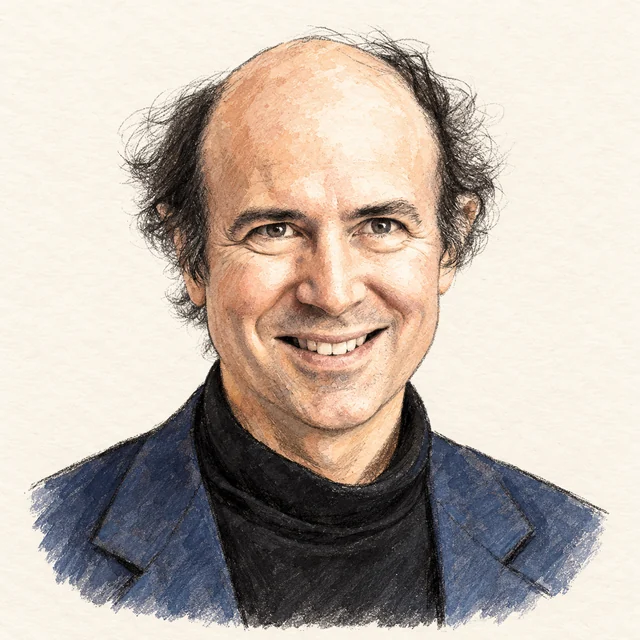
Wilczek was a graduate student at Princeton when he collaborated with David Gross on the strong interaction. He received his doctorate in 1974 and was a professor at MIT at the time of the award. The project joined abstract quantum-field calculations with a concrete experimental puzzle about the apparently free behaviour of quarks in high-energy scattering.
The contribution
Gross and Wilczek showed that the self-interactions of gauge-field carriers can change how the effective coupling evolves with energy. In quantum chromodynamics, gluons carry colour charge and interact with one another as well as with quarks. Their 1973 work helped explain why short-distance processes can be treated with a relatively weak coupling even though the strong interaction binds ordinary matter so effectively.
The idea in plain language
Protons and neutrons contain quarks interacting through gluons. The force is strong enough that isolated quarks are not observed in ordinary experiments. Yet high-energy scattering revealed behaviour resembling collisions with nearly free constituents. A useful theory had to account for both the binding of matter and the simpler behaviour seen when physicists examined very small distances.
Read the full award story ↗