A life in context
The person behind the prize
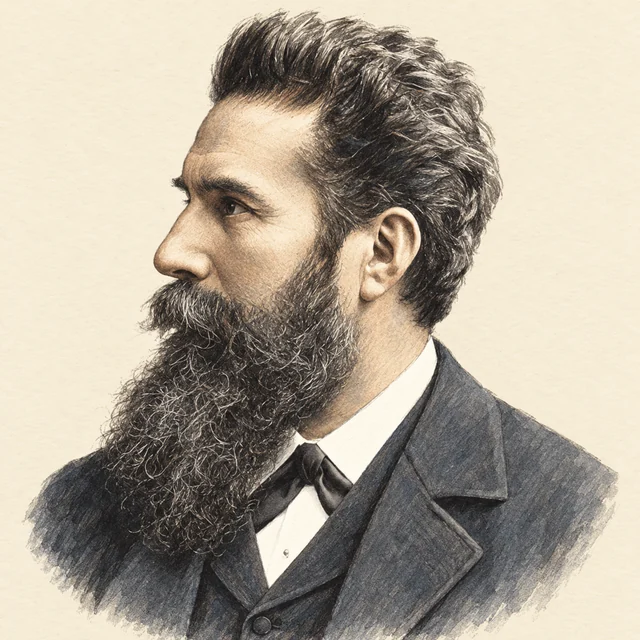
Wilhelm Conrad Röntgen was born in Lennep and grew up mainly in the Netherlands. His route into science was interrupted when he was expelled from a technical school in Utrecht after being blamed for a caricature of a teacher. He subsequently entered the Polytechnic in Zurich, obtained a mechanical engineering diploma in 1868 and completed a doctorate at the University of Zurich in 1869. Working with August Kundt took him to Würzburg and Strasbourg. After appointments at Hohenheim, Strasbourg and Giessen, he returned to Würzburg as professor of physics in 1888. His practical experience with apparatus supported careful experimental work on matter, electricity and radiation. On 8 November 1895, while investigating electrical discharges in gases, he noticed fluorescence beyond a covered discharge tube. The unexpected effect led him to investigate radiation that could pass through some materials opaque to visible light. He called it X-radiation, using X to mark its unknown character. It was distinct from the cathode rays being studied inside discharge tubes; in modern terms, X-rays are electromagnetic radiation, whereas cathode rays are streams of electrons. Röntgen tested penetration, shadows and photographic effects rather than stopping at the initial surprise. A celebrated image of his wife Anna Bertha’s hand and ring made the possibilities vivid, but it should not be described as the first photograph made during the entire investigation. His initial report appeared in December 1895, followed by a public presentation in Würzburg in January 1896. In 1900 he moved to Munich, his affiliation when he received the full first Physics Prize in 1901. The discovery therefore belongs to his Würzburg period, even though the award-year institution was Munich. The medical value came from differences in how tissues and objects attenuate radiation, allowing internal structures or foreign objects to be located. This was a new means of observation, not a claim that every material is transparent or that exposure is harmless. Röntgen did not patent the discovery. He continued his scientific career in Munich and died there in 1923. His story joins an unexpected observation to systematic investigation: chance made the anomaly visible, while sustained measurement established a new physical phenomenon.
The contribution
Röntgen discovered and investigated X-rays in 1895. The full 1901 Physics Prize recognised this new radiation, whose different transmission through materials opened ways to examine structures hidden from visible light.
The idea in plain language
While studying electrical discharges in 1895, Röntgen found fluorescence outside a covered tube. Further experiments established a distinct radiation, its penetration through different materials and its ability to affect photographic plates.
Read the full award story ↗

