01 · The discovery
The idea, in everyday language
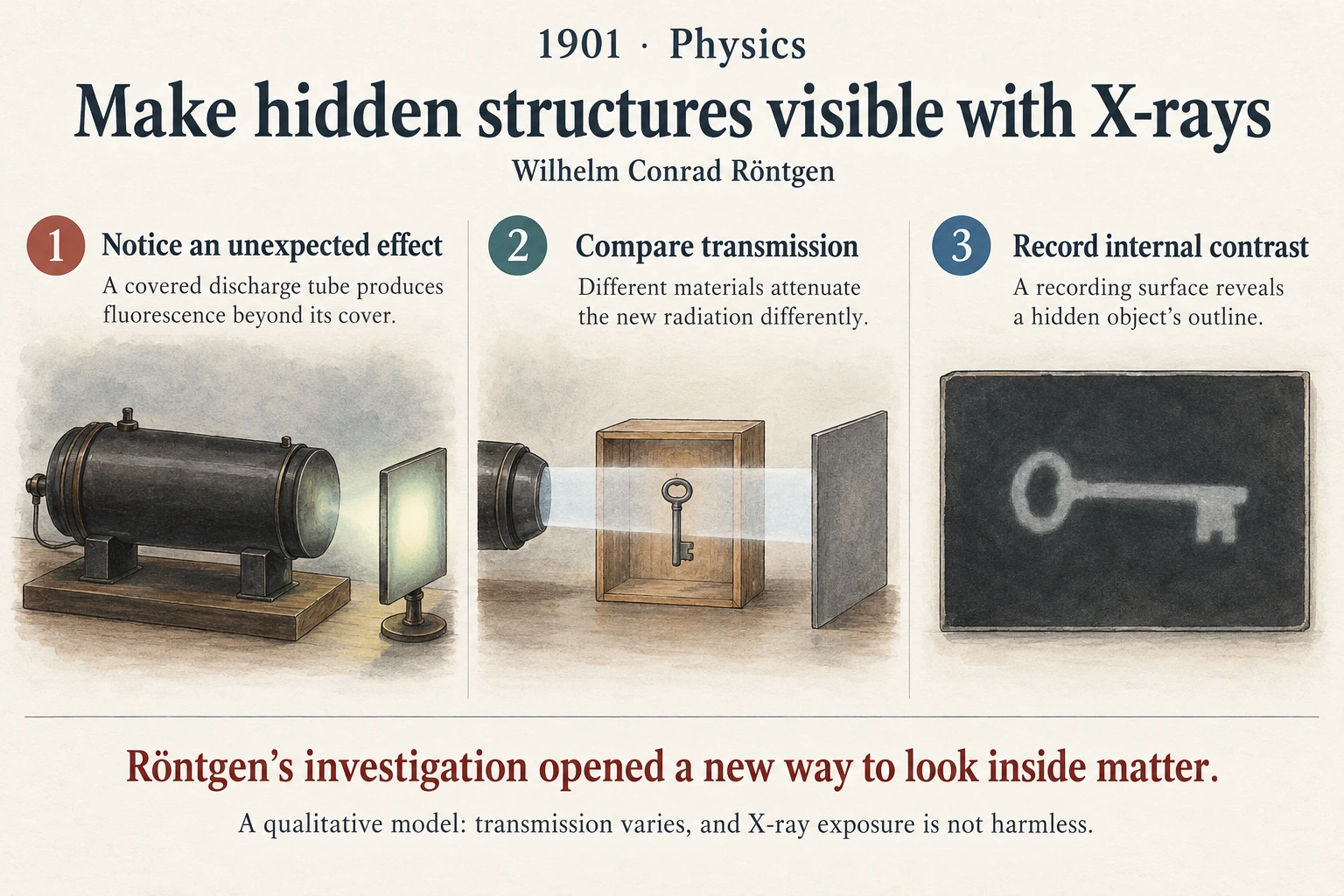
While studying electrical discharges in 1895, Röntgen found fluorescence outside a covered tube. Further experiments established a distinct radiation, its penetration through different materials and its ability to affect photographic plates.
An image forms because different parts of an object attenuate X-rays differently. What reaches a detector varies across the image. In modern terms X-rays are electromagnetic radiation, distinct from the electron streams called cathode rays.
Why it matters
The discovery opened a powerful way to locate hidden structures and foreign objects, especially in medicine, and created new directions for physical research. Later imaging methods developed far beyond the original photographic experiments.