A life in context
The person behind the prize
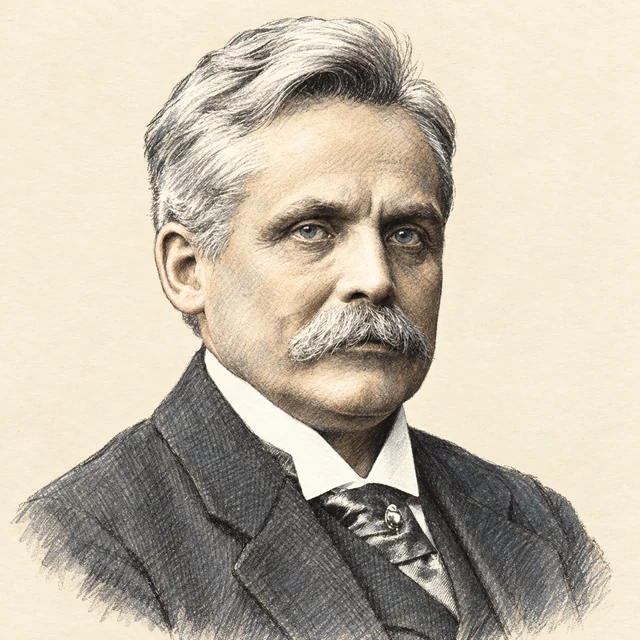
Wilhelm Wien grew up in East Prussia and studied mathematics and physics in Göttingen and Berlin, completing his doctorate in Berlin in 1886 after work in Hermann von Helmholtz’s laboratory. He joined the Physikalisch-Technische Reichsanstalt in 1890. There, the demands of precise measurement met the theoretical problem of how heated bodies emit radiation. In 1893 he established the displacement law linking a blackbody’s temperature to the wavelength of its strongest emission. Work with Otto Lummer on cavity sources in 1895 helped make ideal blackbody radiation accessible to experiment. His spectral radiation law, published in 1896, was an influential further step, but later measurements showed its limits at long wavelengths. Max Planck’s law of 1900 supplied a more general description. Wien taught in Aachen and Giessen before taking the Würzburg chair in 1900, his affiliation for the full 1911 Physics Prize. His research also extended to electrical discharges and charged particles; the award specifically recognised thermal radiation. He moved to Munich in 1920 and died there in 1928. The displacement law, the limited spectral formula and Planck’s later work are distinct contributions, rather than a jointly awarded 1911 discovery.
The contribution
Wien received the full Physics Prize for discoveries concerning the laws of heat radiation. His displacement law made the shift of a blackbody spectrum’s peak with temperature quantitative; his spectral formula helped define the problem that further experiments and Planck’s work would resolve.
The idea in plain language
A blackbody is an ideal absorber and emitter used to study thermal radiation. A small opening in a cavity whose walls share a temperature can approximate it. The radiation contains many wavelengths, each with a different intensity. Wien’s displacement law says that, as absolute temperature rises, the peak of the wavelength spectrum moves towards shorter wavelengths. It is a quantitative relation, not simply the observation that some very hot objects glow.
Read the full award story ↗

