A life in context
The person behind the prize
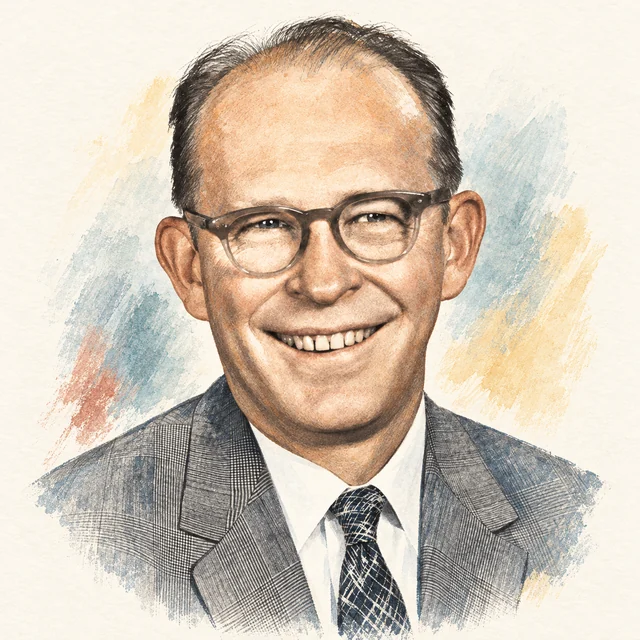
Libby received his Berkeley bachelor’s degree in 1931 and doctorate in 1933, then taught chemistry there. Wartime work at Columbia interrupted a planned fellowship. In 1945 he joined Chicago, where he developed radiocarbon dating. His 1946 proposal connected atmospheric carbon-14 with carbon in living organisms and its radioactive decay after carbon exchange stopped. Ernest Anderson contributed to establishing natural radiocarbon and understanding the carbon cycle; sensitive counters made its very weak activity measurable. With James Arnold, Libby tested samples of known age, reporting the comparison in 1949. His book Radiocarbon Dating appeared in 1952. He joined the US Atomic Energy Commission in 1954 and moved to UCLA in 1959, his award-year affiliation. The 1960 prize recognised a method that transformed archaeology and related sciences. Calibration, contamination and reservoir effects still affect the interpretation of a sample’s age.
The contribution
Libby developed a practical method of estimating the age of biological carbon using carbon-14, with essential contributions from collaborators. He received the full Chemistry Prize.
The idea in plain language
Archaeologists and geologists could often put remains in relative order, but needed independent estimates of elapsed time. A dating method required a natural process whose change could be measured and checked against samples of known age.
Read the full award story ↗

