A life in context
The person behind the prize
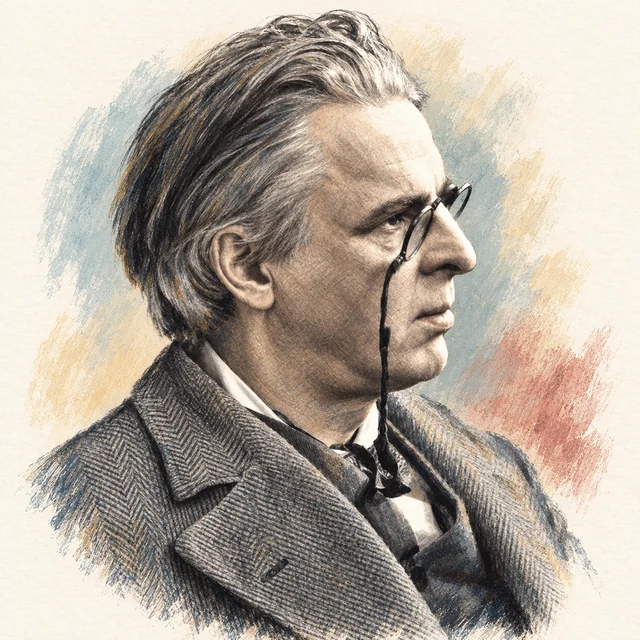
Yeats grew up between Ireland and England in a family shaped by the arts; his father was a portrait painter. Time in western Ireland and an interest in folklore fed his imagination, while literary life in London brought him into contact with symbolism and other artistic movements. His early publications included the dramatic poem Mosada in 1886. He developed a distinctive poetry in English through rhythm, imagery and the reworking of Irish legends. Collections before the Nobel Prize included The Wind among the Reeds, The Wild Swans at Coole and Michael Robartes and the Dancer. He also worked with Lady Gregory to develop the Irish theatre movement, which became associated with the Abbey Theatre. His poetic dramas later experimented with masks, movement and music, drawing on Greek and Japanese models. Appointed to the Irish Senate in 1922, he received the full 1923 Literature Prize for his poetry. His writing continued to change afterwards: The Tower appeared in 1928, beyond the work available to the Academy in 1923. He died in France in 1939. His artistic voice was influential within Irish cultural life, without representing every Irish person or tradition.
The contribution
Yeats received the full Literature Prize for poetry that joined highly individual artistic form with Irish cultural experience. Lyric poetry, poetic drama and his work in the literary revival formed connected parts of that achievement.
The idea in plain language
An inherited story can become something new when a poet changes its rhythm, imagery and point of view. Yeats drew on Irish folklore and legends while developing a highly individual artistic language. The poems are crafted works, rather than transcripts of an unchanged national tradition.
Read the full award story ↗

