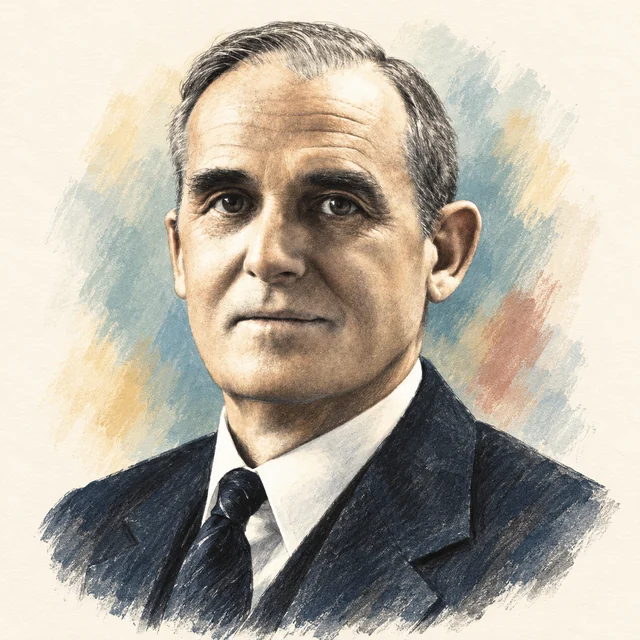
A life in context
The person behind the prize
Born in Niagara Falls in Canada, Giauque moved with his family between Canada and the United States before studying chemistry at Berkeley. He earned his bachelor’s degree in 1920 and his doctorate in chemistry, with a physics minor, in 1922 under G. E. Gibson. He remained at Berkeley, becoming a professor in 1934. Precise measurements of heat capacities and other thermal properties let him investigate entropy and test the third law of thermodynamics. In 1933 he and D. P. MacDougall demonstrated magnetic cooling to temperatures far below those obtainable with liquid helium alone. This did not reach absolute zero. His research also examined residual entropy in substances with frozen orientational disorder, showing why a perfectly ordered crystal is an essential qualification in the ideal third-law reference. Work with H. L. Johnston on oxygen isotopes was a separate contribution. Berkeley was his affiliation for the full 1949 Chemistry Prize, which recognised his wider chemical thermodynamics, especially the behaviour of matter at extremely low temperatures.
The contribution
Giauque combined precise low-temperature measurements with thermodynamic reasoning and developed magnetic cooling with MacDougall. He received the full Chemistry Prize for contributions extending beyond a refrigeration technique.
The idea in plain language
How can chemical thermodynamics describe a substance when it is extremely cold? Measurements of heat capacity and other thermal changes help determine entropy and compare thermodynamic states. Giauque made these measurements unusually precise. With D. P. MacDougall, he demonstrated magnetic cooling in 1933, extending experiments below temperatures accessible with liquid helium alone.
Read the full award story ↗

