01 · The discovery
The idea, in everyday language
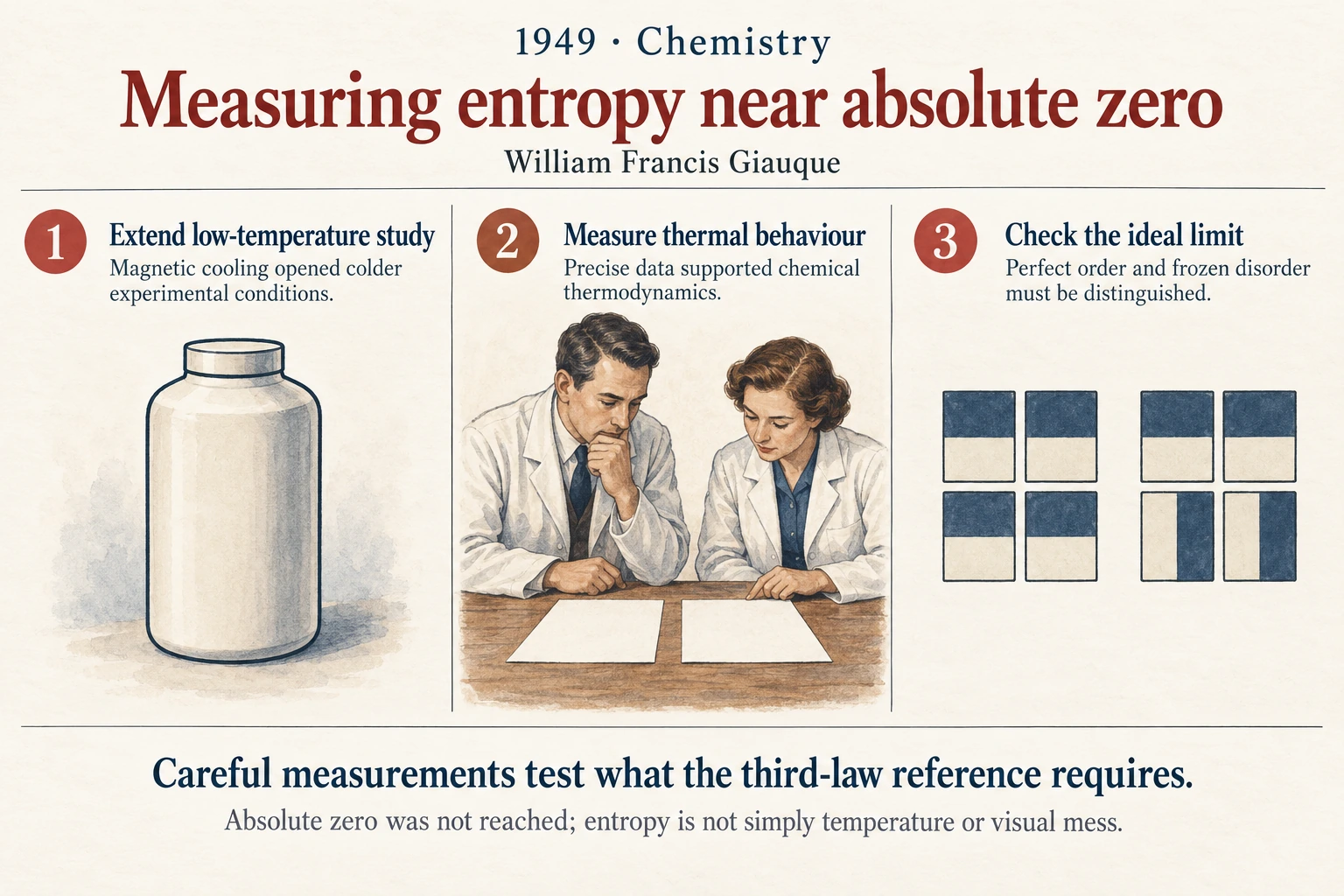
How can chemical thermodynamics describe a substance when it is extremely cold? Measurements of heat capacity and other thermal changes help determine entropy and compare thermodynamic states. Giauque made these measurements unusually precise. With D. P. MacDougall, he demonstrated magnetic cooling in 1933, extending experiments below temperatures accessible with liquid helium alone.
The third-law reference assigns zero entropy at absolute zero to an ideally perfect, ordered crystal. Real substances can retain frozen arrangements that do not have this complete order. Giauque’s work examined such residual entropy, including orientational disorder in carbon monoxide, and tested the conditions under which thermodynamic predictions and measurements agree. The prize covered these wider contributions, not refrigeration alone.
Why it matters
Reliable low-temperature data strengthened chemical thermodynamics and the use of entropy in understanding material properties and chemical changes. The work linked experimental precision with careful treatment of the reference state, rather than assuming every cold solid must behave identically.