01 · The discovery
The idea, in everyday language
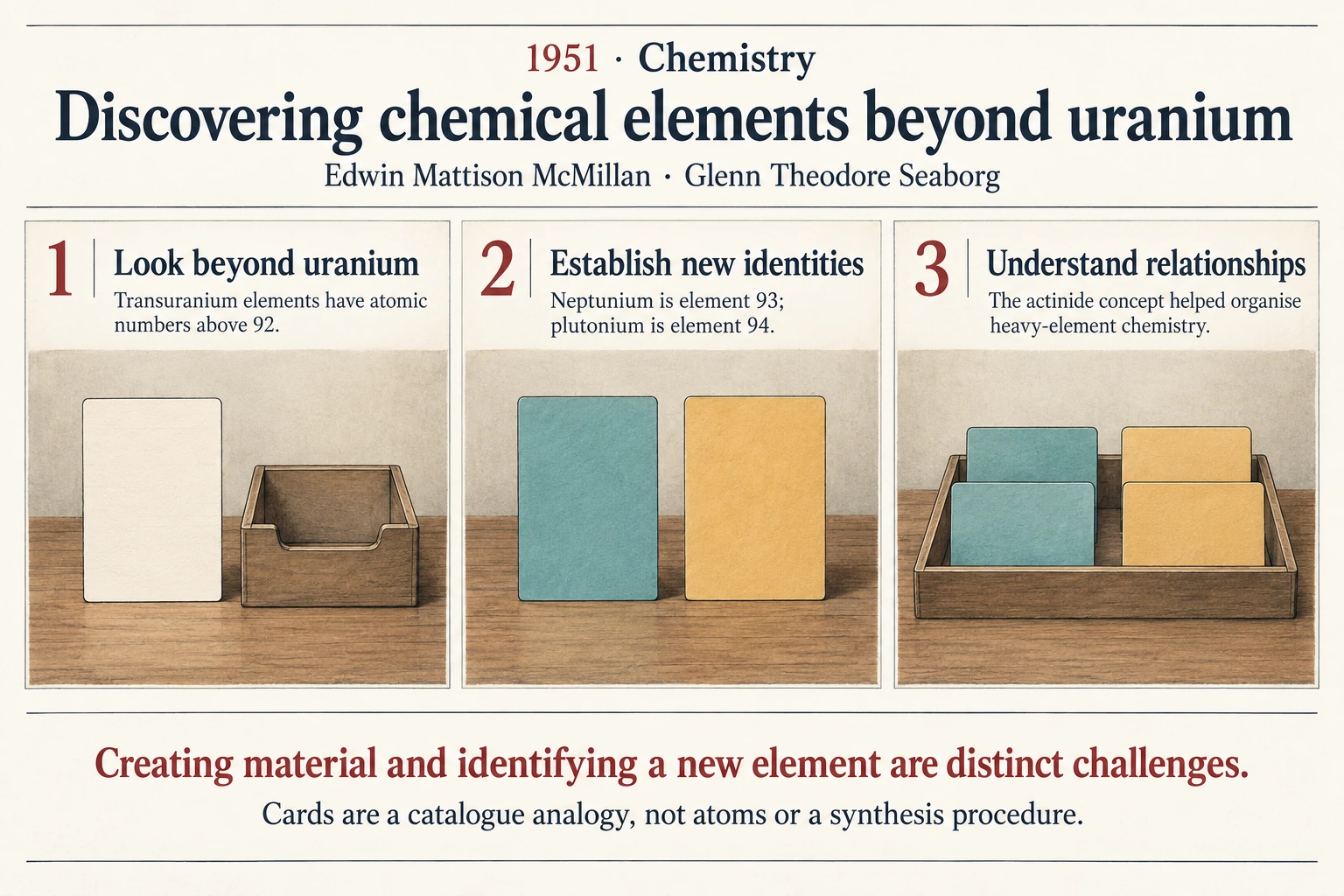
An element is defined by the number of protons in its nucleus. Uranium has 92; identifying something beyond it requires evidence for a different chemical element, not just a heavier isotope of uranium. In 1940 McMillan and Philip Abelson identified neptunium, atomic number 93. Chemical behaviour and radioactive evidence helped distinguish it from known material.
Work begun with McMillan led Seaborg, Joseph Kennedy and Arthur Wahl to the chemical identification of plutonium, atomic number 94, in February 1941. Seaborg’s 1944 actinide concept helped organise heavy-element chemistry through relationships among their electron structures and properties. By the 1951 award, the known transuranium elements extended through californium; subsequent discoveries belong to later history.
Why it matters
The work enlarged the periodic system and connected nuclear transformations with chemical identification. McMillan and Seaborg received one half each, while collaborators were essential to the discoveries. These elements also became tied to nuclear energy and weapons, with major consequences beyond the scientific identification itself.