A life in context
The person behind the prize
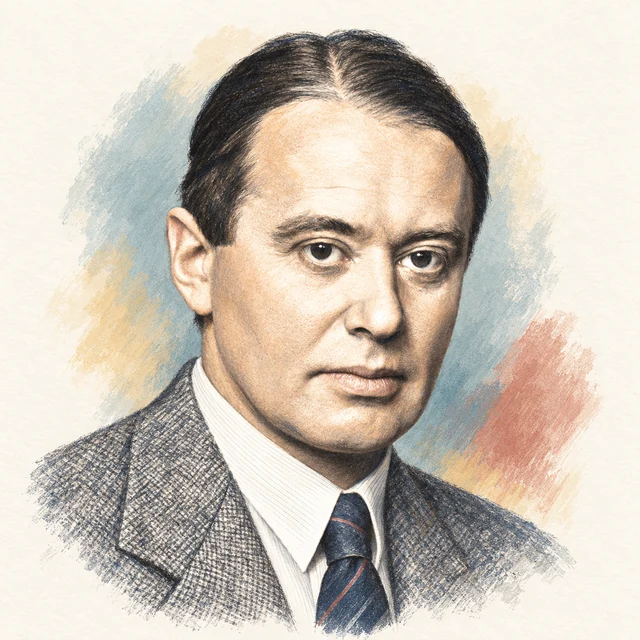
Tiselius grew up in Sweden and studied chemistry at Uppsala after finishing school in 1921. He became an assistant in The Svedberg’s laboratory in 1925 and completed his doctorate in 1930 on the moving-boundary method of studying protein electrophoresis. Investigations of diffusion and adsorption in zeolites, and a research visit to H. S. Taylor’s Princeton laboratory, broadened his approach to physical chemistry. Returning to protein research, he published a much improved electrophoretic method in 1937. A special research professorship was established for him at Uppsala in 1938, and biochemistry became an independent department there in 1946. His methods helped distinguish components of serum proteins and supported biochemical analysis. Adsorption research, including work with Stig Claesson, was another part of the recognised contribution. He received the full 1948 Chemistry Prize with Uppsala as his affiliation. The institute’s new building in 1950–1952 and his later presidencies of IUPAC and the Nobel Foundation should not be treated as already held in 1948.
The contribution
Tiselius made electrophoresis and adsorption analysis powerful tools for separating and characterising mixtures, especially serum proteins. He received the full Chemistry Prize for these methods and discoveries, rather than for inventing every form of separation.
The idea in plain language
How can a mixture be understood without treating it as a single substance or destroying its components? In electrophoresis, charged molecules migrate in an electric field. Differences in their motion can help distinguish them. Tiselius carefully studied disturbances and improved the moving-boundary method in solution, making protein measurements more reliable.
Read the full award story ↗

