A life in context
The person behind the prize
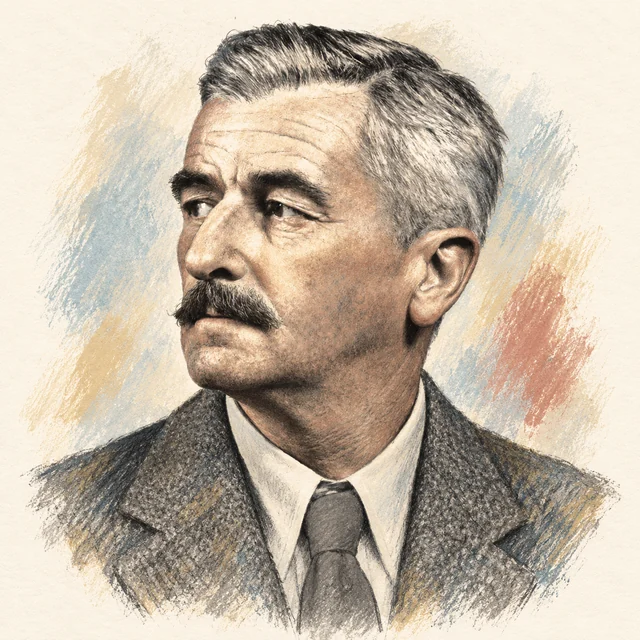
Faulkner grew up in Mississippi, where family stories, reading and the people around him helped shape his literary imagination. His fictional Yoknapatawpha County drew on the region while becoming an invented world with its own intertwined histories. He experimented with shifts of voice, inner monologue and disrupted chronology to show how people remember, conceal and interpret the past. The Sound and the Fury appeared in 1929, Sanctuary in 1931, Light in August in 1932 and Absalom, Absalom! in 1936; The Hamlet followed in 1940 and Intruder in the Dust in 1948. The 1949 Literature Prize recognised his powerful, distinctive contribution to the modern American novel as a whole. It was reserved and presented to him on 10 December 1950. His Canadian flying training during the First World War did not involve combat; later accounts of combat injuries were a myth, including in the presentation speech. Later novels such as Requiem for a Nun and The Reivers were not already published in 1949.
The contribution
Faulkner developed innovative narrative voices and structures in modern American fiction, exploring memory, social power and the legacies of racism. He received the full 1949 Literature Prize in 1950.
The idea in plain language
How can a novel show that people inhabit different versions of the same past? Faulkner let narrative voices, memories and the order of events unsettle a simple account. Long, densely worked sentences and colloquial speech could sit alongside abrupt changes in perspective. The reader must attend to who is speaking, what they know and what their account leaves out.
Read the full award story ↗

