A life in context
The person behind the prize
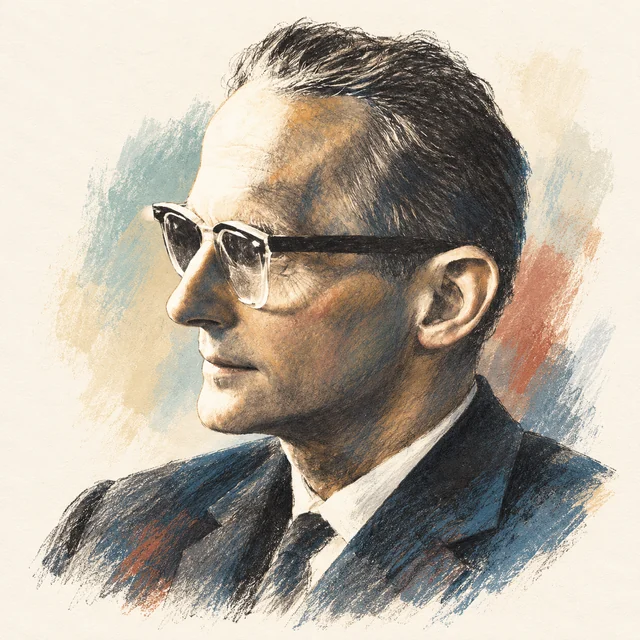
Lipscomb was born in Cleveland and grew up in Lexington, Kentucky. After studying at the University of Kentucky he entered Caltech in 1941, initially in physics. Linus Pauling’s influence drew him back to chemistry. He completed his doctorate and joined Minnesota in 1946, moving to Harvard in 1959. From the early 1950s his group combined X-ray diffraction, structural reasoning and quantum calculations to investigate boranes and related compounds. These molecules challenged the expectation that every bond could be explained by one electron pair shared between two atoms. His 1963 book Boron Hydrides brought together this research. From around 1960 he also studied enzyme structures and their relation to catalysis and regulation. The Nobel award specifically concerned boranes and the understanding of chemical bonding.
The contribution
Lipscomb received the full Chemistry Prize for determining and explaining borane structures. Multicentre bonding helped account for stable arrangements where ordinary two-centre bonds alone were insufficient.
The idea in plain language
Boron and hydrogen form a varied family of compounds called boranes. Compared with a simple hydrocarbon picture, there are too few valence electrons to assign an ordinary two-centre, two-electron bond to every connection suggested by their structures. The solution is not to invent missing electrons. Some electron pairs are shared over more than two atomic centres, including three-centre bonding. Electron distribution must be considered across the molecular framework rather than forced into an unsuitable collection of pairwise links.
Read the full award story ↗

