A life in context
The person behind the prize
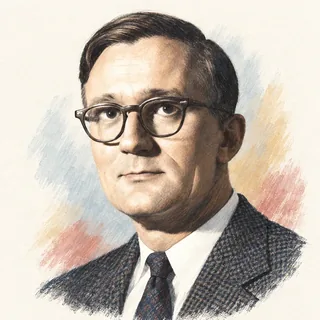
Lamb studied at Berkeley, receiving a chemistry bachelor’s degree in 1934 and a doctorate in theoretical physics in 1938 under Robert Oppenheimer. His thesis concerned electromagnetic properties of nuclear systems. He joined Columbia in 1938 and became professor in 1948. Work in its Radiation Laboratory during and after the war connected theoretical analysis with microwave methods. With Robert C. Retherford, he reported a hydrogen fine-structure measurement in August 1947: two states expected to have the same energy in the earlier Dirac account were separated. The result became known as the Lamb shift and helped redirect quantum electrodynamics. He moved to Stanford in 1951, his affiliation at the 1955 award, and received half of the prize for the fine structure of hydrogen. Kusch received the other half for a different precision measurement. Lamb’s Oxford appointment from 1956 and Yale appointment in 1962 belong to later history. The 1947 experimental collaborator is credited separately from the prize recipients.
The contribution
Lamb established the small separation between hydrogen energy states previously expected to coincide, working experimentally with Retherford. He received one half of the Physics Prize.
The idea in plain language
How accurately did the existing quantum description match atoms? With Robert C. Retherford, Lamb used microwave methods to investigate hydrogen. Their August 1947 report established that two states expected to coincide in the earlier Dirac description actually had slightly different energies. The Lamb shift became a demanding test for a theory including the interaction of matter with the electromagnetic field.
Read the full award story ↗