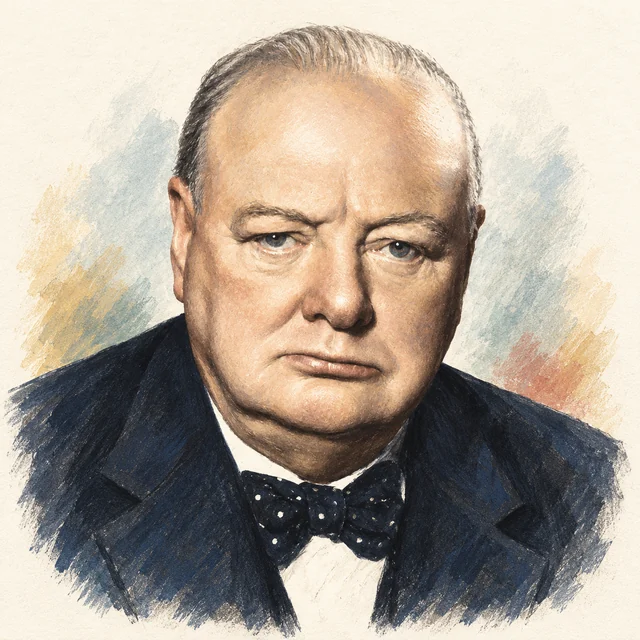
A life in context
The person behind the prize
Churchill trained at Harrow and Sandhurst before army service, journalism and election to Parliament in 1900. Writing accompanied his political career: early campaign accounts led to biographies, histories, memoirs and collected speeches. Lord Randolph Churchill appeared in 1906, My Early Life in 1930 and the four-volume Marlborough between 1933 and 1938. His Second World War memoirs began appearing in 1948. He was prime minister from 1940 to 1945 and again from 1951, so he held that office at the 1953 award. He was also knighted in 1953. The Literature Prize recognised historical and biographical writing and oratory, rather than awarding him the Peace Prize. His wife Clementine accepted on his behalf. The later History of the English-speaking Peoples, published in 1956–1958, was not a published work at the award. His histories should be read with attention to the perspective of a participant in political events.
The contribution
Churchill was recognised for historical and biographical writing and for public oratory. He received the full Literature Prize, distinct from the 1953 Peace Prize awarded to Marshall.
The idea in plain language
How can an account of public events hold a reader’s attention while presenting people, decisions and consequences? Churchill combined historical narration, biography and the perspective of a political participant. His writing extended from early campaign reports to Lord Randolph Churchill, The World Crisis and Marlborough, as well as wartime memoirs.
Read the full award story ↗

