A life in context
The person behind the prize
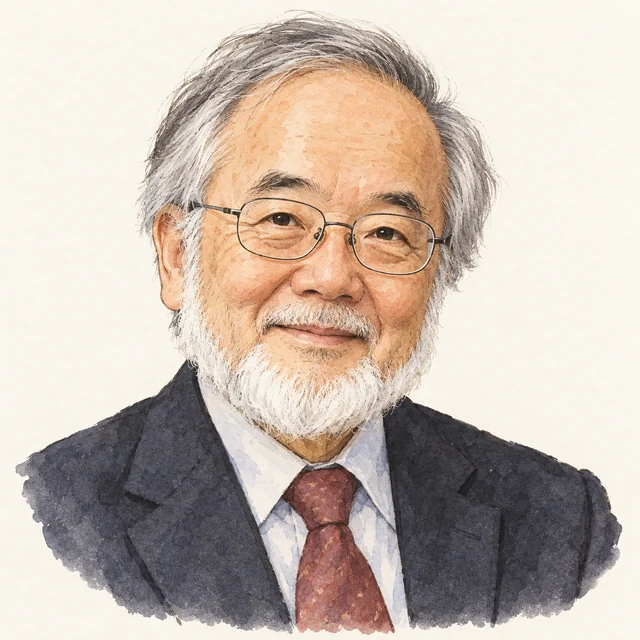
Ohsumi studied at the University of Tokyo, where he received his doctorate in 1974. After research at Rockefeller University, he returned to Tokyo and established his own group in 1988. He later worked in Okazaki and at Tokyo Institute of Technology. His decisive experiments used baker’s yeast, a modest organism whose genetics made it possible to investigate a recycling process that was difficult to see directly.
The contribution
He made autophagic material accumulate visibly inside yeast vacuoles by disabling its breakdown, then searched for mutations that prevented this accumulation. The experiments identified essential genes and opened a path to working out the machinery of autophagy, including related processes in human cells.
The idea in plain language
Cells need ways to dismantle material and reuse its building blocks. In one route, a growing membrane surrounds some cellular contents and closes to form an autophagosome. This package delivers its cargo to a compartment with digestive enzymes: a lysosome in human cells, or a vacuole in yeast. The contents are broken into smaller components that the cell can use again. Scientists had observed the process decades earlier, but its machinery was poorly understood.
Read the full award story ↗