c.curionodeThe Nobel Archive

2016 · Physiology or Medicine

How a cell recycles its own parts

Yeast experiments revealed the machinery behind autophagy.

autophagyyeast geneticscellular recycling
2016Physiology or Medicine

Visual guide

The prize, pictured

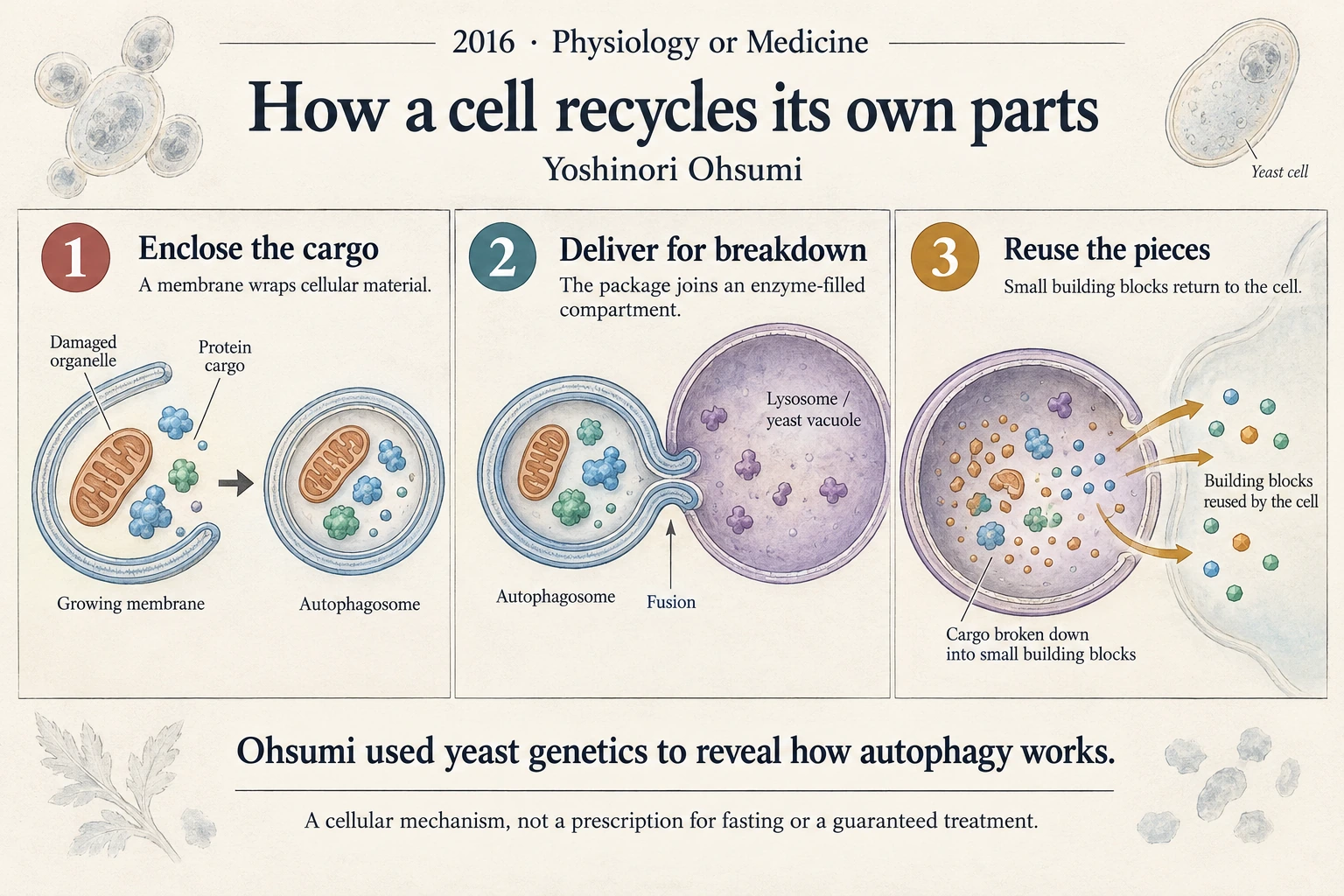
Infographic explaining How a cell recycles its own parts
Original AI-generated infographic. A conceptual overview; the explanations and sources below provide context.
Read the poster text

Ohsumi used yeast genetics to reveal how autophagy works.

  1. Enclose the cargo

    A membrane wraps cellular material.

  2. Deliver for breakdown

    The package joins an enzyme-filled compartment.

  3. Reuse the pieces

    Small building blocks return to the cell.

A cellular mechanism, not a prescription for fasting or a guaranteed treatment.

01 · The discovery

The idea, in everyday language

Cells need ways to dismantle material and reuse its building blocks. In one route, a growing membrane surrounds some cellular contents and closes to form an autophagosome. This package delivers its cargo to a compartment with digestive enzymes: a lysosome in human cells, or a vacuole in yeast. The contents are broken into smaller components that the cell can use again. Scientists had observed the process decades earlier, but its machinery was poorly understood.

Ohsumi made the process experimentally accessible. He used yeast lacking enzymes needed for breakdown in the vacuole, then deprived the cells of nutrients. Material delivered by autophagy accumulated instead of disappearing, so it could be seen under a microscope. He then searched for additional mutations that stopped the accumulation. This strategy identified genes essential for autophagy and made it possible to investigate what their proteins do at different stages.

Why it matters

The research provided tools for understanding cellular renewal, responses to nutrient shortage and the removal of damaged components. Related machinery operates in human cells. It also made autophagy accessible to research on disease, where its effects depend on the tissue, condition and stage.
02 · The people

Who brought the idea to life?

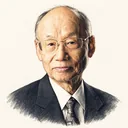
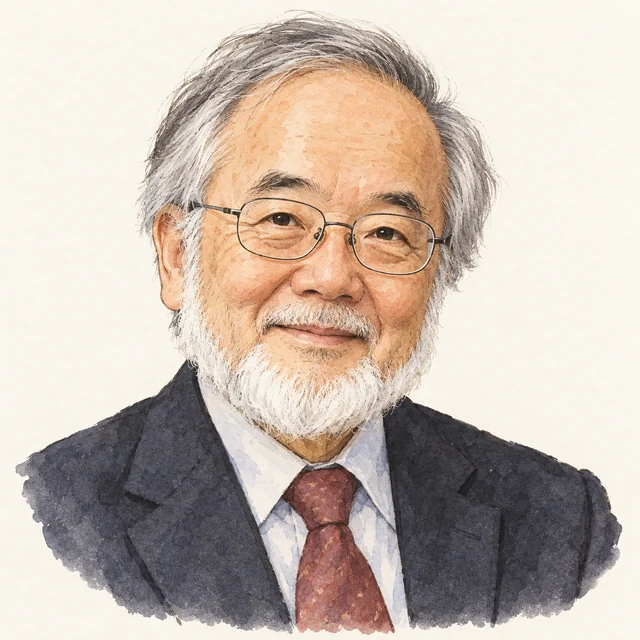
Illustrated portrait of Yoshinori Ohsumi

Yoshinori Ohsumi

Prize share · 1/1

He made autophagic material accumulate visibly inside yeast vacuoles by disabling its breakdown, then searched for mutations that prevented this accumulation. The experiments identified essential genes and opened a path to working out the machinery of autophagy, including related processes in human cells.

Read the biography ↗

03 · Years in the making

The path here

  1. 1992

    Experiments make autophagic material visible in yeast vacuoles.

  2. 1993

    A genetic screen identifies mutants defective in autophagy.

  3. 2016

    Ohsumi receives the prize for discoveries of autophagy mechanisms.

04 · Read further

From the original sources

Original explanations by Curionode, based on the official records below. Biographical details and affiliations refer to the award year.

  1. Official award announcement nobelprize.org
  2. Scientific background nobelprize.org

More in Physiology or Medicine

Browse this subject ↗