c.curionodeThe Nobel Archive

1911 · Literature

Let silence and suggestion carry a drama

Maeterlinck made anticipation, uncertainty and what remains unseen central to dramatic experience. His Symbolist plays, poetry and essays gave poetic form to inner life and questions that ordinary stage action could leave unspoken.

SymbolismDramaPoetic imagination
1911Literature

Visual guide

The prize, pictured

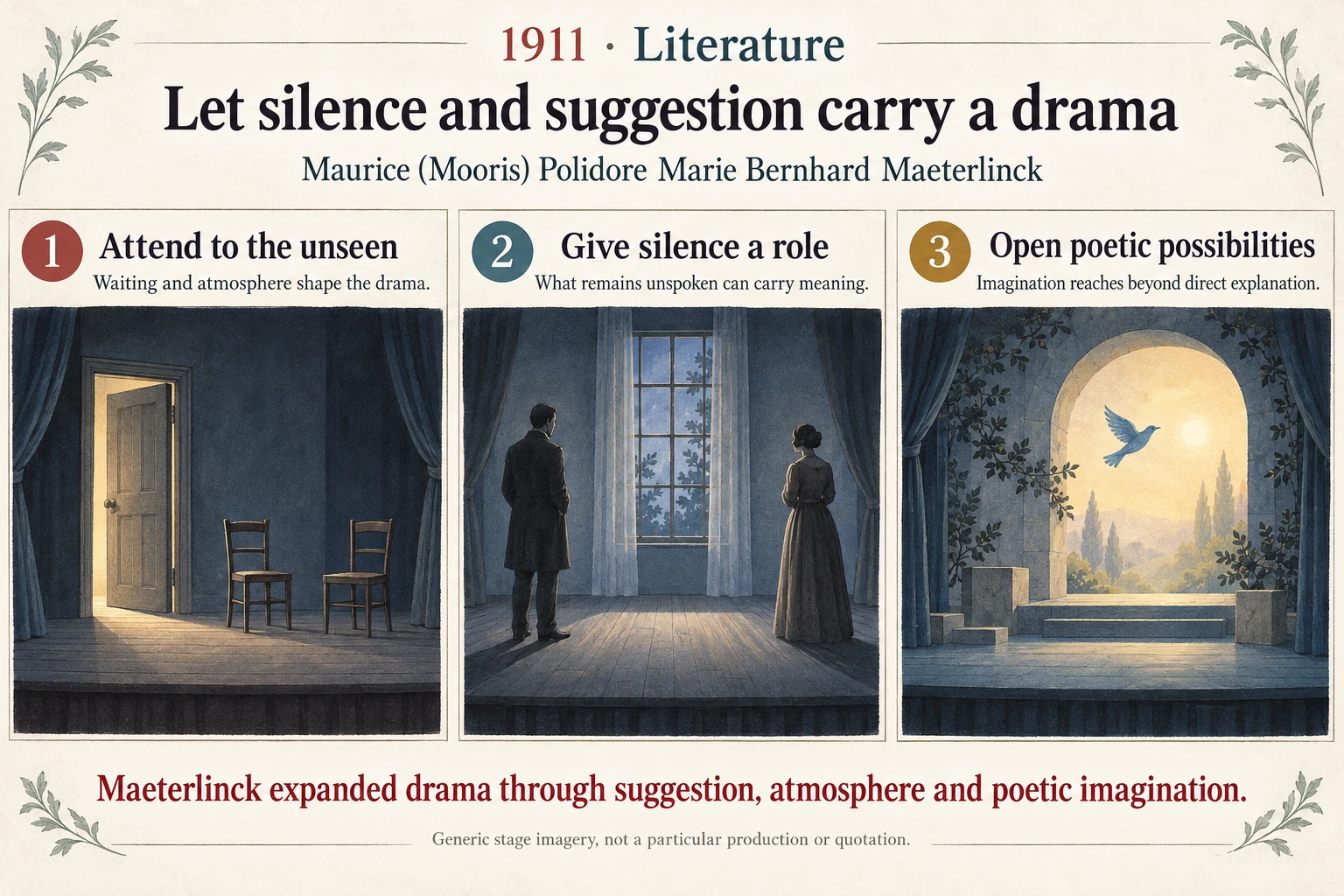
Infographic explaining Let silence and suggestion carry a drama
Original AI-generated infographic. A conceptual overview; the explanations and sources below provide context.
Read the poster text

Maeterlinck expanded drama through suggestion, atmosphere and poetic imagination.

  1. Attend to the unseen

    Waiting and atmosphere shape the drama.

  2. Give silence a role

    What remains unspoken can carry meaning.

  3. Open poetic possibilities

    Imagination reaches beyond direct explanation.

Generic stage imagery, not a particular production or quotation.

01 · The contribution

The idea, in everyday language

A play need not depend only on visible conflict and decisive action. In The Intruder and The Blind, waiting and incomplete knowledge give ordinary sounds and pauses unusual force. Characters encounter things they cannot fully understand or control. The audience’s attention moves towards apprehension and inner experience; a silence can matter as much as an event shown onstage.

His writing also changed over time. The early, often sombre dramas differed from the more hopeful fairy-tale journey of The Blue Bird, first performed in Moscow in 1908. Poetry, reflective essays and works such as Pelléas et Mélisande and Aglavaine et Sélysette formed a wider achievement. The 1911 citation singled out the dramatic works within that range, rather than awarding a single book or defining every work as equally pessimistic.

Why it matters

His work widened the expressive resources of modern drama. Suggestion, atmosphere and restrained action could evoke experiences that a direct explanation might flatten. The plays also travelled across languages and into other arts, with later interpretations taking their own forms.

02 · The people

Who brought the idea to life?

03 · Years in the making

The path here

  1. 1862

    Maeterlinck is born in Ghent.

  2. 1889

    Serres chaudes and La Princesse Maleine appear.

  3. 1890

    The Intruder and The Blind are published.

  4. 1892

    Pelléas et Mélisande is published.

  5. 1901

    The Life of the Bee appears.

  6. 1908

    The Blue Bird has its world premiere in Moscow.

  7. 1911

    The Blue Bird reaches Paris; Maeterlinck receives the Literature Prize.

04 · Read further

From the original sources

Original explanations by Curionode, based on the official records below. Biographical details and affiliations refer to the award year.

  1. Official award summary nobelprize.org
  2. Award ceremony speech nobelprize.org
  3. City of Ghent: Maeterlinck’s literary life stad.gent

More in Literature

Browse this subject ↗