c.curionodeThe Nobel Archive

1917 · Peace

Keep news and assistance moving across wartime separation

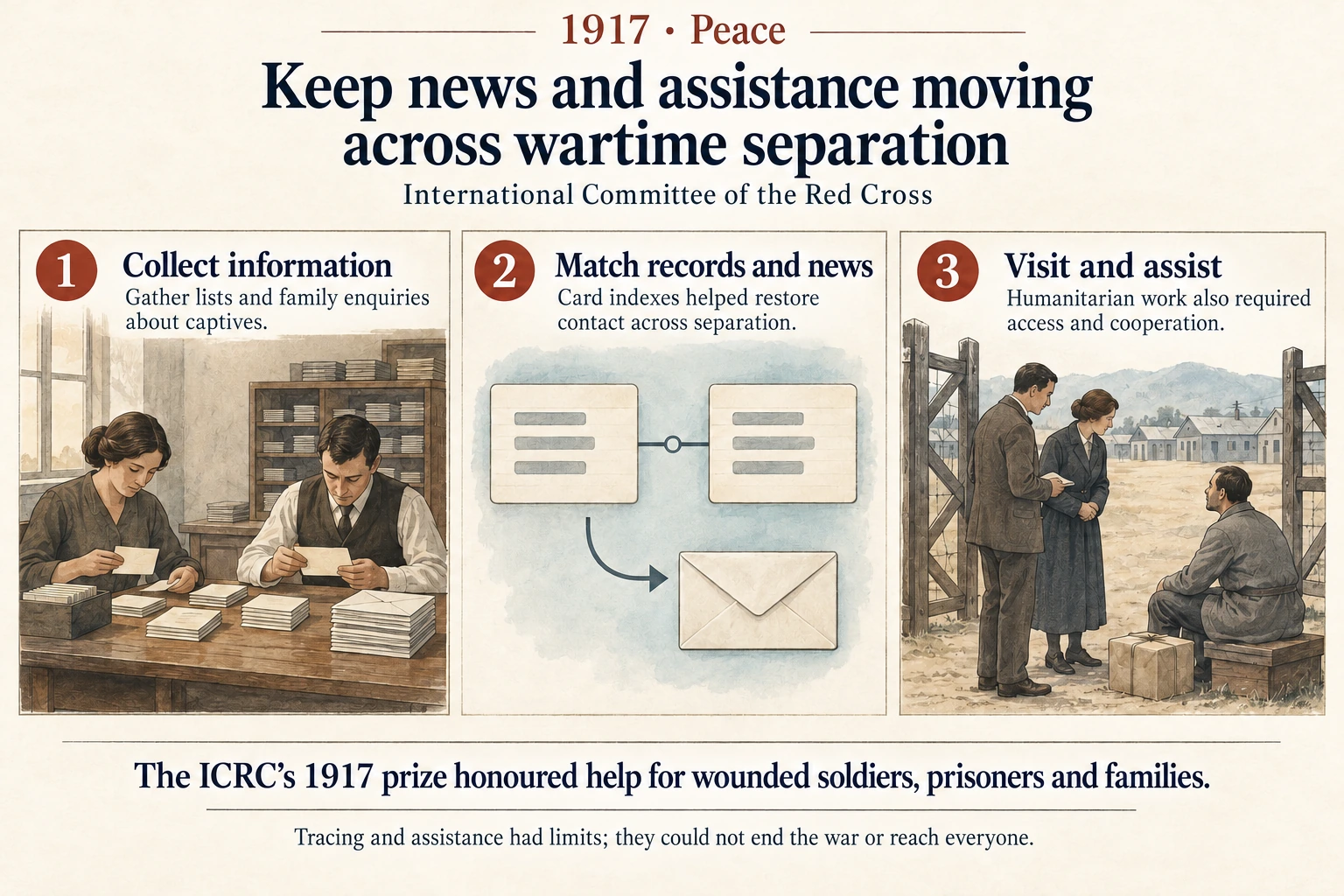
The ICRC’s 1917 Peace Prize recognised help for wounded soldiers, prisoners of war and their families. Its prisoners agency connected official information with enquiries from people who had lost contact.

Prisoners of warFamily contactHumanitarian assistance
1917Peace

Visual guide

The prize, pictured

Infographic explaining Keep news and assistance moving across wartime separation
Original AI-generated infographic. A conceptual overview; the explanations and sources below provide context.
Read the poster text

The ICRC’s 1917 prize honoured help for wounded soldiers, prisoners and families.

  1. Collect information

    Gather lists and family enquiries about captives.

  2. Match records and news

    Card indexes helped restore contact across separation.

  3. Visit and assist

    Humanitarian work also required access and cooperation.

Tracing and assistance had limits; they could not end the war or reach everyone.

01 · The contribution

The idea, in everyday language

War separated prisoners and wounded people from families who often did not know where they were or whether they were alive. The ICRC established its International Prisoners-of-War Agency in Geneva in August 1914. Lists from authorities and enquiries from relatives could be compared through card indexes. Volunteers and staff maintained those records and passed available information back to families.

The work went beyond a filing system. Delegates sought permission to visit prisoner-of-war camps, while the organisation supported relief and efforts to exchange or repatriate sick and wounded captives. Coverage was incomplete and other organisations also played major roles. The award ceremony was held on 10 December 1917. Nobel’s presentation page explains that the original speech text is unavailable and instead publishes a historical account; it should not be mistaken for a verbatim transcript of that speech.

Why it matters

Finding a name in a record could reduce uncertainty and make renewed contact possible. Visits and assistance addressed the practical conditions of captivity and injury. These humanitarian achievements mattered within a continuing war, while gaps in access, information and protection remained.

02 · The recipients

Who brought the idea to life?

Symbolic illustration representing International Committee of the Red Cross

International Committee of the Red Cross

Prize share · 1

The ICRC received the full Peace Prize for its work for wounded soldiers, prisoners of war and their families. The agency’s information work, humanitarian visits and assistance provided practical help during the First World War without implying that it could stop the conflict or reach everyone.

Read the biography ↗

03 · Years in the making

The path here

  1. 1863

    The Geneva committee is founded.

  2. 1864

    The first Geneva Convention is adopted.

  3. 1914

    The International Prisoners-of-War Agency is set up in Geneva in August.

  4. 1915

    The ICRC begins prisoner-of-war camp inspections in Germany, Britain and France in January.

  5. 1917

    The ICRC receives the full Peace Prize; the ceremony takes place on 10 December.

  6. 1944

    The same committee receives another Peace Prize.

  7. 1963

    The committee shares the Peace Prize with the League of Red Cross Societies.

04 · Read further

From the original sources

Original explanations by Curionode, based on the official records below. Biographical details and affiliations refer to the award year.

  1. Official award summary nobelprize.org
  2. Historical presentation account nobelprize.org
  3. ICRC: the First World War and the prisoners agency icrc.org