c.curionodeThe Nobel Archive

1932 · Physics

Replacing electron orbits with quantum relations

Heisenberg’s 1925 approach described atomic transitions through quantities tied to observation. With Born and Jordan, it developed into matrix mechanics, a foundation of quantum theory.

Matrix mechanicsAtomic transitionsQuantum theoryOrtho and para hydrogen
1932Physics

Visual guide

The prize, pictured

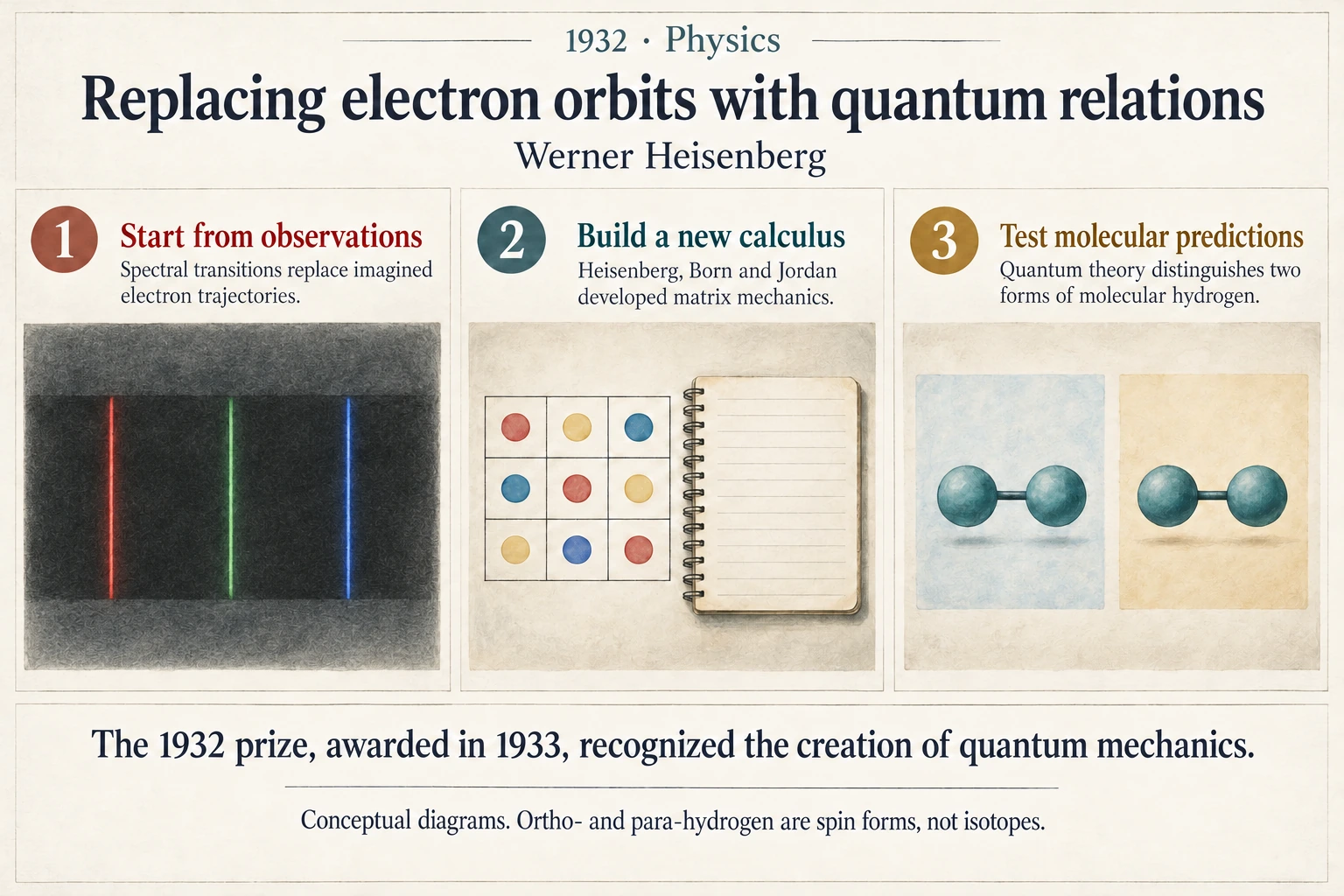
Infographic explaining Replacing electron orbits with quantum relations
Original AI-generated infographic. A conceptual overview; the explanations and sources below provide context.
Read the poster text

The 1932 prize, awarded in 1933, recognized the creation of quantum mechanics.

  1. Start from observations

    Spectral transitions replace imagined electron trajectories.

  2. Build a new calculus

    Heisenberg, Born and Jordan developed matrix mechanics.

  3. Test molecular predictions

    Quantum theory distinguishes two forms of molecular hydrogen.

Conceptual diagrams. Ortho- and para-hydrogen are spin forms, not isotopes.

01 · The discovery

The idea, in everyday language

The old quantum theory mixed classical electron orbits with special rules for allowed energies. It worked in some cases but struggled with more complicated atoms. Heisenberg changed the starting point: rather than draw an unobserved trajectory, relate the frequencies and strengths of transitions that appear in atomic spectra. The resulting quantities could be arranged in arrays. Born and Jordan helped develop the matrix mathematics, in which the order of multiplication matters.

This new mechanics supplied rules for calculating atomic and molecular behaviour. One application concerned two forms of molecular hydrogen, now called ortho- and para-hydrogen, associated with different nuclear-spin states and rotational possibilities. These are not the hydrogen isotopes distinguished by nuclear mass, such as the deuterium recognized in the 1934 Chemistry Prize. Heisenberg’s uncertainty relation followed in 1927: quantum states have limits on how sharply position and momentum can be specified together. The 1932 Physics Prize was reserved and awarded in 1933, alongside the separate 1933 prize for Schrödinger and Dirac.

Why it matters

Matrix mechanics helped replace an inadequate orbit picture with a coherent quantum framework. Its agreement with atomic and molecular observations made the theory useful for further research. The achievement belonged to a wider development involving Born, Jordan, Schrödinger, Dirac and other theorists and experimenters, even though the 1932 award named Heisenberg alone.
02 · The people

Who brought the idea to life?

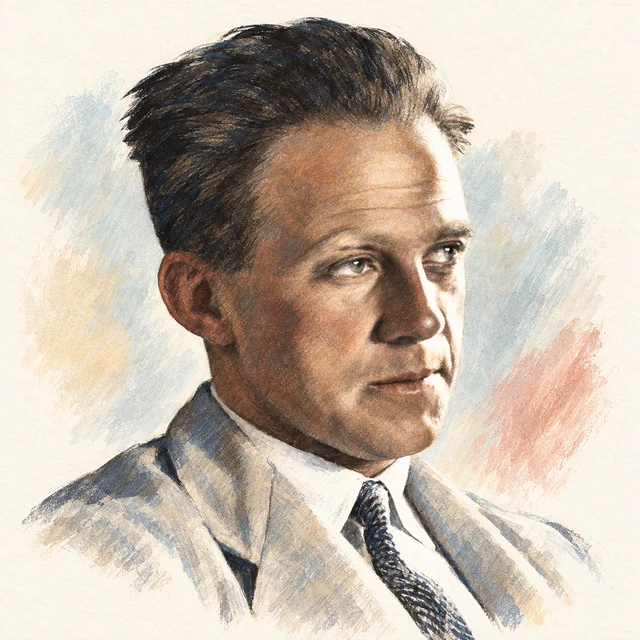
Illustrated portrait of Werner Heisenberg

Werner Heisenberg

Prize share · 1

Heisenberg received the full 1932 Physics Prize, awarded in 1933, for creating quantum mechanics and its applications. His 1925 approach helped replace classical electron trajectories with a calculational framework for atomic transitions.

Read the biography ↗

03 · Years in the making

The path here

  1. 1925

    Heisenberg develops the new approach; Born and Jordan help formulate matrix mechanics.

  2. 1927

    Heisenberg presents the uncertainty relation and becomes professor in Leipzig.

  3. 1933

    The reserved 1932 prize is announced on 9 November and presented in December.

04 · Read further

From the original sources

Original explanations by Curionode, based on the official records below. Biographical details and affiliations refer to the award year.

  1. Official award summary nobelprize.org
  2. Award ceremony speech nobelprize.org
  3. Official biography: Max Born nobelprize.org
  4. NIST: hydrogen spin isomers nist.gov