c.curionodeThe Nobel Archive

1933 · Physics

New mathematical languages for the atom

Schrödinger’s wave mechanics made atomic states calculable. Dirac brought quantum mechanics together with special relativity in an electron theory that opened a route to predicting the positron.

Wave mechanicsQuantum statesDirac equationPositron
1933Physics

Visual guide

The prize, pictured

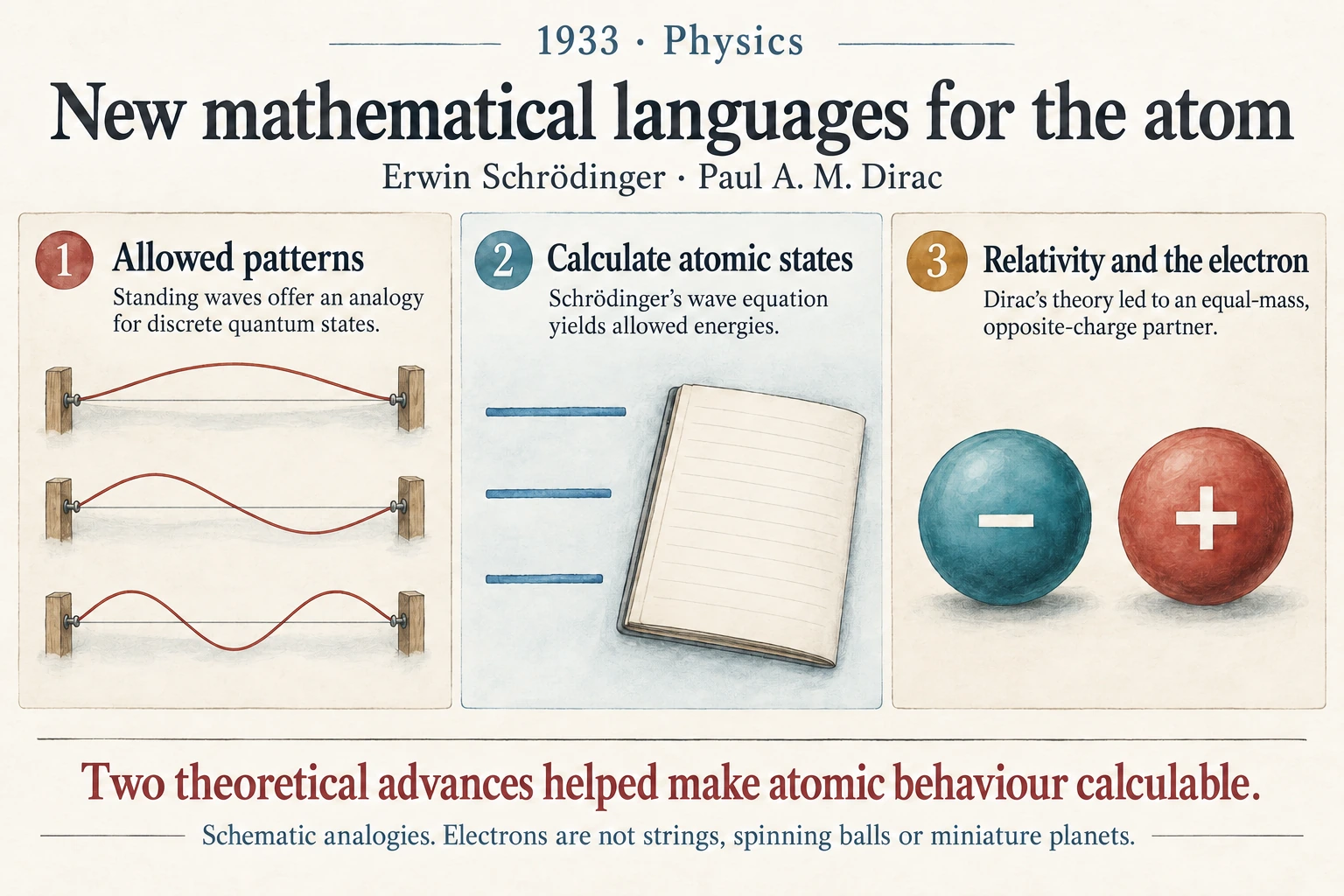
Infographic explaining New mathematical languages for the atom
Original AI-generated infographic. A conceptual overview; the explanations and sources below provide context.
Read the poster text

Two theoretical advances helped make atomic behaviour calculable.

  1. Allowed patterns

    Standing waves offer an analogy for discrete quantum states.

  2. Calculate atomic states

    Schrödinger’s wave equation yields allowed energies.

  3. Relativity and the electron

    Dirac’s theory led to an equal-mass, opposite-charge partner.

Schematic analogies. Electrons are not strings, spinning balls or miniature planets.

01 · The discovery

The idea, in everyday language

A classical picture of electrons circling a nucleus could not adequately explain atomic behaviour. In 1926 Schrödinger developed a wave equation whose solutions describe quantum states. For a bound system, the allowed solutions give particular energy values, helping explain why atomic spectra contain distinct lines. The wavefunction is a mathematical description; its squared magnitude determines position probabilities in the appropriate representation. It is not a photograph of an electron stretched into water waves.

Dirac sought a quantum description consistent with special relativity. His 1928 electron equation incorporated spin and relativistic motion. Its unusual solutions raised interpretive problems; after further work, he proposed an anti-electron in 1931, with the electron’s mass but opposite electric charge. Anderson observed the positron in 1932. Schrödinger and Dirac shared the 1933 prize for theoretical advances, while Anderson’s experimental discovery was recognized in 1936. The approaches are connected parts of quantum theory, rather than competing pictures of tiny planetary orbits.

Why it matters

These formulations gave physicists powerful ways to calculate atomic behaviour and helped establish modern quantum theory. They underpin later work across physics and chemistry. The route from an equation to a new particle also shows how mathematical consistency can suggest experimental questions, while observation remains essential.
02 · The people

Who brought the idea to life?

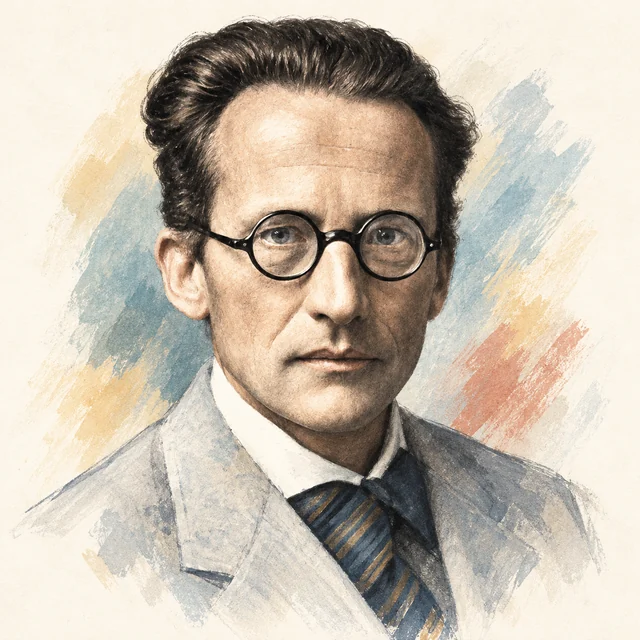
Illustrated portrait of Erwin Schrödinger

Erwin Schrödinger

Prize share · 1/2

Schrödinger received half the Physics Prize for developing a productive form of atomic theory. His wave equation connected atomic states with allowed energies and made quantum calculations more usable.

Read the biography ↗
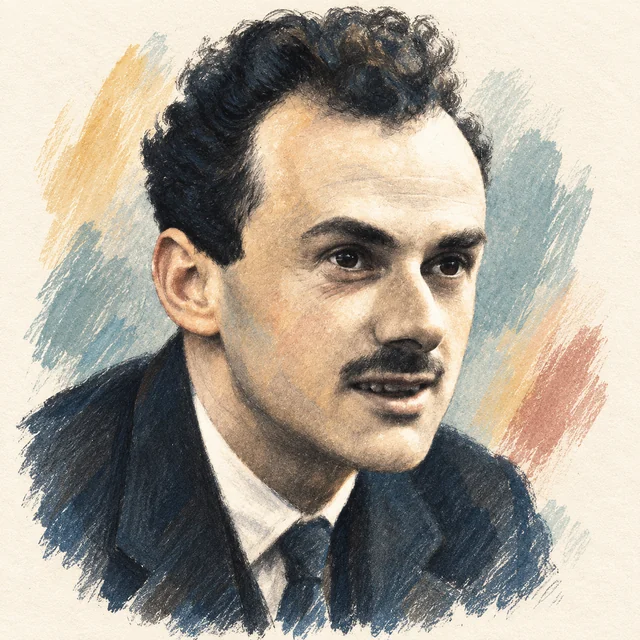
Illustrated portrait of Paul A. M. Dirac

Paul A. M. Dirac

Prize share · 1/2

Dirac received half the Physics Prize for developing a productive form of atomic theory. His relativistic treatment of the electron brought quantum mechanics and special relativity together and led, through further interpretation, to the anti-electron prediction.

Read the biography ↗

03 · Years in the making

The path here

  1. 1926

    Schrödinger develops wave mechanics in Zurich.

  2. 1928

    Dirac publishes his relativistic electron equation.

  3. 1931

    Dirac proposes the anti-electron; Anderson’s detection follows in 1932.

  4. 1933

    Schrödinger and Dirac share the Physics Prize equally.

04 · Read further

From the original sources

Original explanations by Curionode, based on the official records below. Biographical details and affiliations refer to the award year.

  1. Official award summary nobelprize.org
  2. Award ceremony speech nobelprize.org
  3. CERN: antimatter home.cern
  4. CERN: the anti-electron prediction and discovery ep-news-wp.web.cern.ch
  5. Oxford: Schrödinger at Magdalen magd.ox.ac.uk
  6. Contemporary report: the 1933 Physics Prize nature.com