A life in context
The person behind the prize
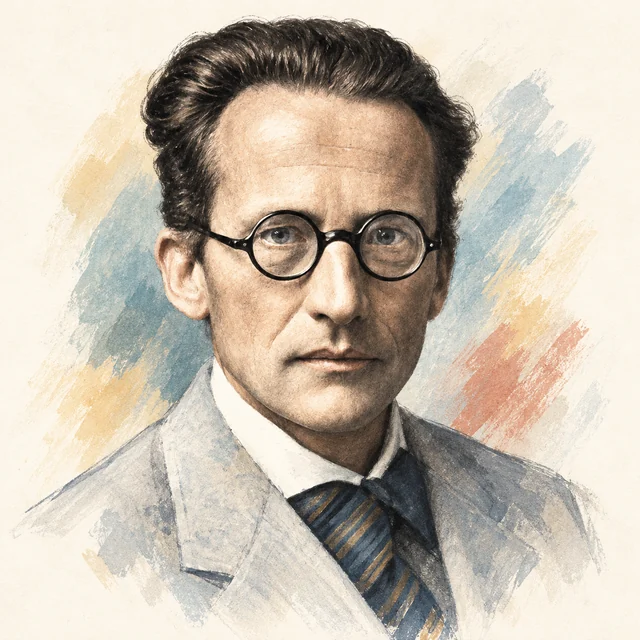
Schrödinger studied physics in Vienna and developed a broad interest in mathematics, philosophy and the physical sciences. After work in several European universities, he became professor in Zurich in 1921. There, in 1926, he developed wave mechanics: an equation that could describe atomic states and yield their allowed energies. He also showed how this approach connected with the matrix mechanics developed by Heisenberg and others. In 1927 he succeeded Max Planck in Berlin. He left Germany in 1933 and joined Magdalen College, Oxford, before the Nobel award. The official Nobel facts record still lists Berlin as his award affiliation; its statement that he left in 1934 conflicts with the Nobel biography and Oxford’s history. He shared the 1933 Physics Prize equally with Dirac. Later moves took him to Graz and, after fleeing Austria in 1938, eventually Dublin. His cat thought experiment dates from 1935 and his book What Is Life? from 1944; neither was the work being awarded in 1933.
The contribution
Schrödinger received half the Physics Prize for developing a productive form of atomic theory. His wave equation connected atomic states with allowed energies and made quantum calculations more usable.
The idea in plain language
A classical picture of electrons circling a nucleus could not adequately explain atomic behaviour. In 1926 Schrödinger developed a wave equation whose solutions describe quantum states. For a bound system, the allowed solutions give particular energy values, helping explain why atomic spectra contain distinct lines. The wavefunction is a mathematical description; its squared magnitude determines position probabilities in the appropriate representation. It is not a photograph of an electron stretched into water waves.
Read the full award story ↗