c.curionodeThe Nobel Archive

1939 · Physiology or Medicine

Find antibacterial activity in a red dye

Domagk’s investigation of Prontosil helped establish a new direction in synthetic antibacterial chemotherapy.

ProntosilSulfonamidesAntibacterial chemotherapyProdrug
1939Physiology or Medicine

Visual guide

The prize, pictured

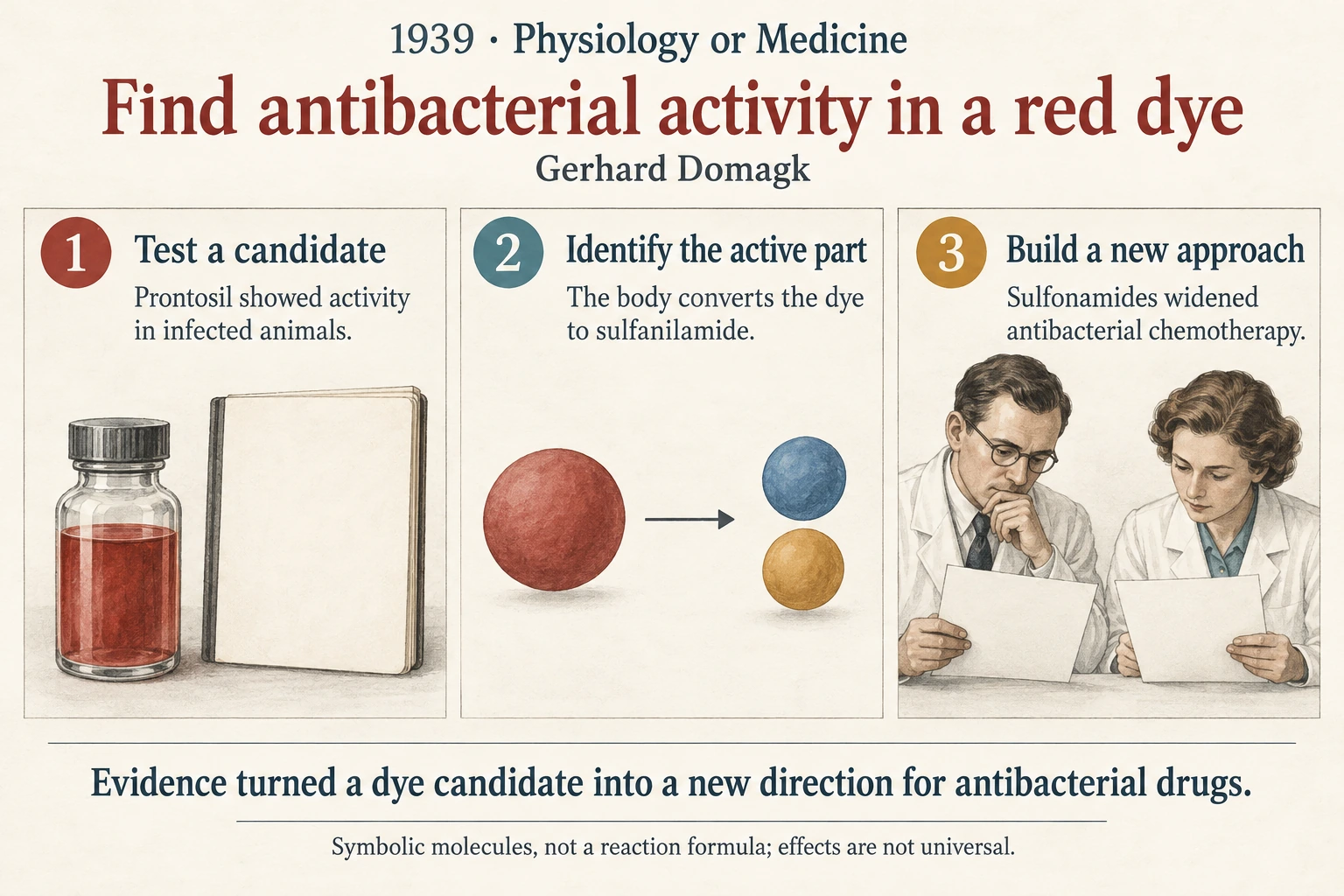
Infographic explaining Find antibacterial activity in a red dye
Original AI-generated infographic. A conceptual overview; the explanations and sources below provide context.
Read the poster text

Evidence turned a dye candidate into a new direction for antibacterial drugs.

  1. Test a candidate

    Prontosil showed activity in infected animals.

  2. Identify the active part

    The body converts the dye to sulfanilamide.

  3. Build a new approach

    Sulfonamides widened antibacterial chemotherapy.

Symbolic molecules, not a reaction formula; effects are not universal.

01 · The discovery

The idea, in everyday language

Bacterial infections could turn an injury or an operation into a life-threatening event. Researchers wanted chemicals that could act against an infection inside a living body. At the Elberfeld industrial laboratories, Domagk directed biological investigations alongside the synthetic work of Mietzsch and Klarer. In 1932 Prontosil, a red dye compound, protected infected animals in experiments. Results published in 1935 prompted further investigations in several countries.

The red dye was not the end of the chemical story. The body converts Prontosil to an active antibacterial component, sulfanilamide. Thérèse and Jacques Tréfouël, Daniel Bovet and Federico Nitti at the Institut Pasteur contributed to understanding the active component in 1935. Subsequent work broadened the sulfonamide family. Domagk’s cited discovery concerned Prontosil’s antibacterial effects; it did not make him the sole inventor of every sulfonamide or of antibacterial treatment.

Why it matters

The finding strengthened the case for systematic chemical approaches to bacterial disease and helped change the prospects for treating several serious infections. Biological testing, chemical identification and clinical investigation were different stages involving many people. Success with one compound and one kind of bacterium did not establish universal effectiveness against infections or viruses.
02 · The people

Who brought the idea to life?

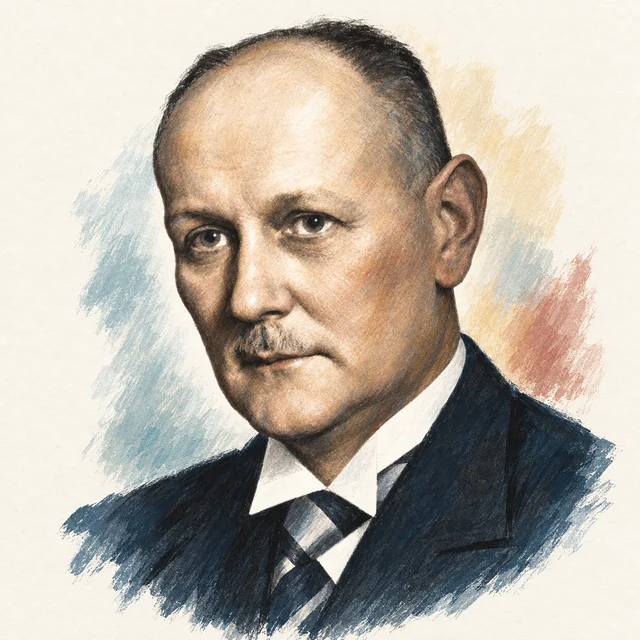
Illustrated portrait of Gerhard Domagk

Gerhard Domagk

Prize share · 1

Domagk received the whole Medicine Prize for discovering the antibacterial effects of Prontosil. The work combined his biological investigations with chemical synthesis and subsequent international research.

Read the biography ↗

03 · Years in the making

The path here

  1. 1921

    Domagk completes medical qualification at Kiel.

  2. 1925

    He takes up a pathology post at Münster.

  3. 1932

    Prontosil shows antibacterial activity in animal investigations.

  4. 1935

    Domagk publishes the results; Pasteur researchers identify the active component.

  5. 1939

    The Medicine Prize recognises the antibacterial discovery.

  6. 1947

    Domagk receives the 1939 medal and diploma.

04 · Read further

From the original sources

Original explanations by Curionode, based on the official records below. Biographical details and affiliations refer to the award year.

  1. Official award summary nobelprize.org
  2. Award ceremony speech nobelprize.org
  3. Institut Pasteur: the Tréfouëls and sulfonamides pasteur.fr
  4. American Chemical Society: Prontosil and its active component acs.org
  5. Official biography: Gerhard Domagk nobelprize.org

More in Physiology or Medicine

Browse this subject ↗