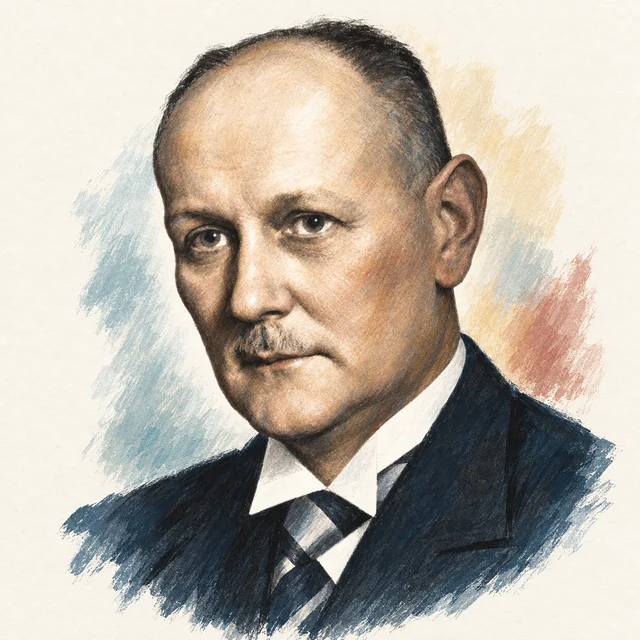
A life in context
The person behind the prize
Domagk’s medical studies at Kiel were interrupted by the First World War. Service in military medical facilities exposed him to the severe consequences of infection. He qualified in 1921 and pursued pathology, working in Greifswald and then Münster. Alongside his university connection he undertook industrial research at Elberfeld, within I.G. Farben, the group that included Bayer. There he directed biological testing in collaboration with chemists Fritz Mietzsch and Josef Klarer. Prontosil, a red dye candidate, showed striking antibacterial activity in animal studies in 1932; the results were published in 1935. Researchers in other countries investigated the finding and developed the sulfonamide field. Work at the Institut Pasteur by Thérèse and Jacques Tréfouël, Daniel Bovet and Federico Nitti helped identify the active antibacterial component. His whole 1939 Medicine Prize recognised the discovery of Prontosil’s antibacterial effects. The Nazi authorities forced him to decline the award at the time; he received its medal and diploma in 1947. His later tuberculosis research was separate from the cited Prontosil discovery.
The contribution
Domagk received the whole Medicine Prize for discovering the antibacterial effects of Prontosil. The work combined his biological investigations with chemical synthesis and subsequent international research.
The idea in plain language
Bacterial infections could turn an injury or an operation into a life-threatening event. Researchers wanted chemicals that could act against an infection inside a living body. At the Elberfeld industrial laboratories, Domagk directed biological investigations alongside the synthetic work of Mietzsch and Klarer. In 1932 Prontosil, a red dye compound, protected infected animals in experiments. Results published in 1935 prompted further investigations in several countries.
Read the full award story ↗