01 · The discovery
The idea, in everyday language
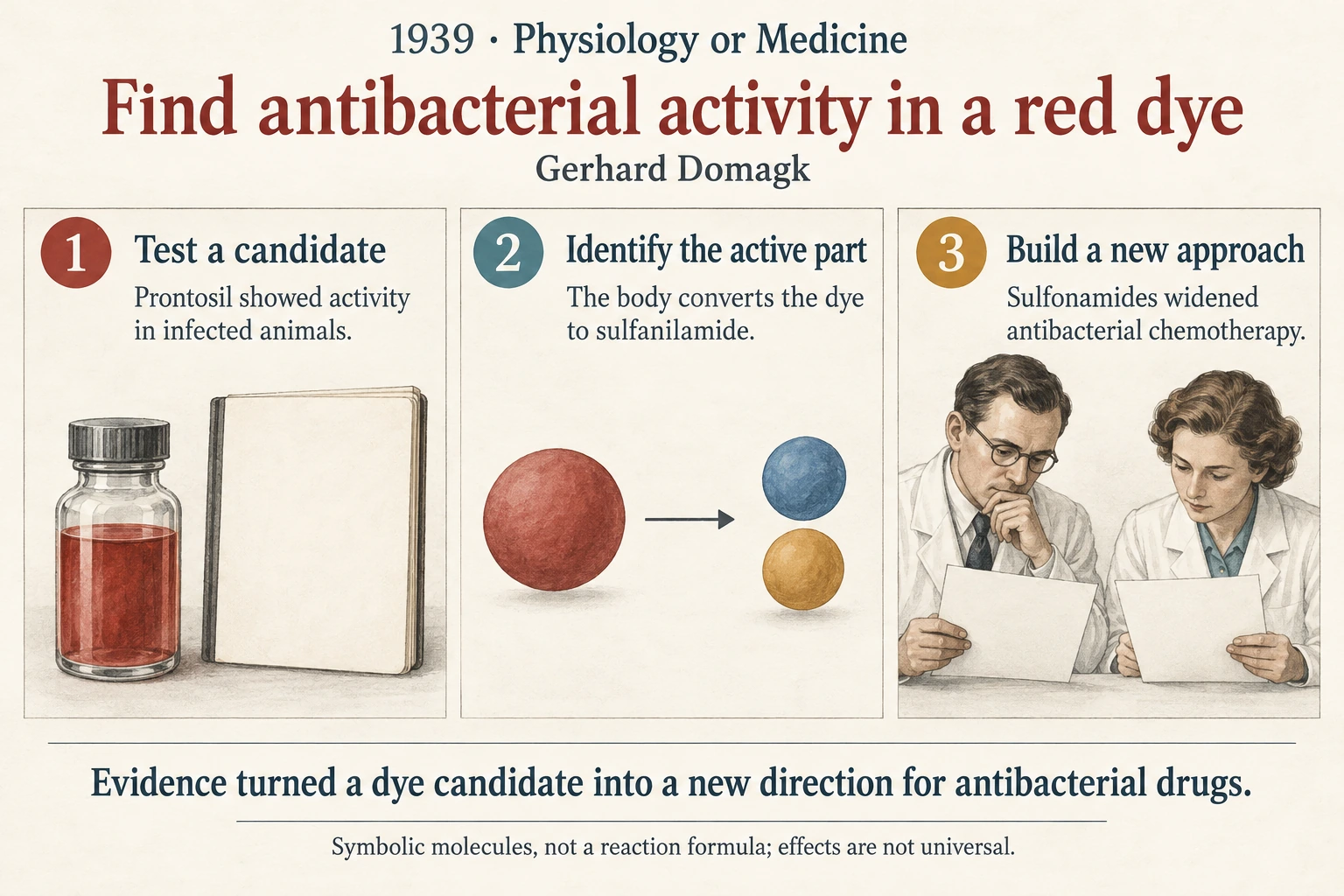
Bacterial infections could turn an injury or an operation into a life-threatening event. Researchers wanted chemicals that could act against an infection inside a living body. At the Elberfeld industrial laboratories, Domagk directed biological investigations alongside the synthetic work of Mietzsch and Klarer. In 1932 Prontosil, a red dye compound, protected infected animals in experiments. Results published in 1935 prompted further investigations in several countries.
The red dye was not the end of the chemical story. The body converts Prontosil to an active antibacterial component, sulfanilamide. Thérèse and Jacques Tréfouël, Daniel Bovet and Federico Nitti at the Institut Pasteur contributed to understanding the active component in 1935. Subsequent work broadened the sulfonamide family. Domagk’s cited discovery concerned Prontosil’s antibacterial effects; it did not make him the sole inventor of every sulfonamide or of antibacterial treatment.
Why it matters
The finding strengthened the case for systematic chemical approaches to bacterial disease and helped change the prospects for treating several serious infections. Biological testing, chemical identification and clinical investigation were different stages involving many people. Success with one compound and one kind of bacterium did not establish universal effectiveness against infections or viruses.