c.curionodeThe Nobel Archive

1939 · Physics

Reuse the push to explore the nucleus

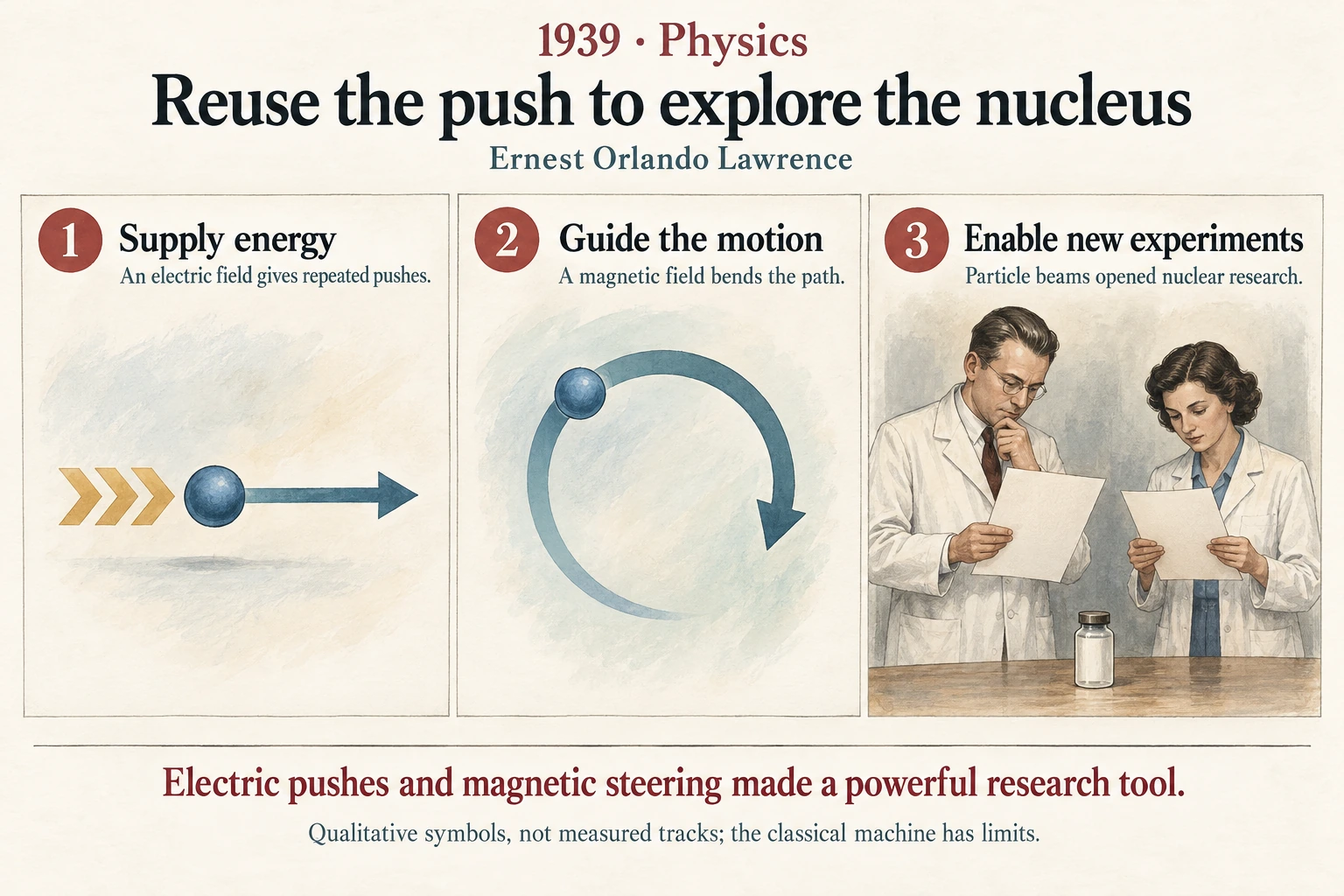
Lawrence’s cyclotron accelerated charged particles through repeated electric pushes while a magnetic field bent their path back around.

CyclotronElectric fieldMagnetic steeringNuclear research
1939Physics

Visual guide

The prize, pictured

Infographic explaining Reuse the push to explore the nucleus
Original AI-generated infographic. A conceptual overview; the explanations and sources below provide context.
Read the poster text

Electric pushes and magnetic steering made a powerful research tool.

  1. Supply energy

    An electric field gives repeated pushes.

  2. Guide the motion

    A magnetic field bends the path.

  3. Enable new experiments

    Particle beams opened nuclear research.

Qualitative symbols, not measured tracks; the classical machine has limits.

01 · The discovery

The idea, in everyday language

Nuclear experiments needed energetic particles that could be directed at matter. One approach used a very large voltage to supply energy in a single passage. Lawrence’s idea was to make the same accelerating region useful repeatedly: a magnetic field returned charged particles to it, while an alternating electric field supplied another push at the appropriate part of their journey.

The two fields have different jobs. The electric field adds kinetic energy; the magnetic field bends the moving charge’s path. In the classical cyclotron, increasing energy means wider orbits while the circulation can stay in step with a fixed-frequency electric field over a useful range. The device became an effective source of particle beams for nuclear reactions and artificial radioactive isotopes. Lawrence’s organisation and the work of Livingston and many other collaborators turned an idea into a research instrument.

Why it matters

The instrument expanded what could be tested in nuclear physics and made radioactive isotopes more accessible to research in chemistry, biology and medicine. This was a platform for many investigators, not a claim that Lawrence discovered every isotope or invented artificial radioactivity. Later accelerator designs extended the energies and capabilities beyond the classical cyclotron.
02 · The people

Who brought the idea to life?

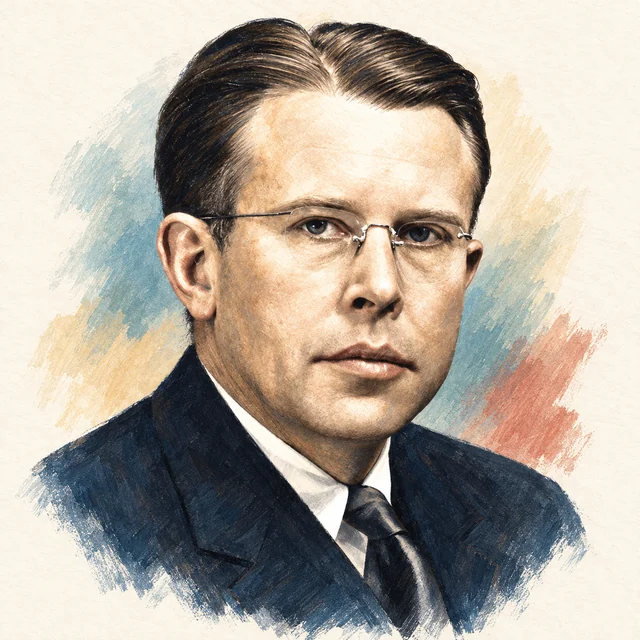
Illustrated portrait of Ernest Orlando Lawrence

Ernest Orlando Lawrence

Prize share · 1

Lawrence received the whole Physics Prize for inventing and developing the cyclotron and for results obtained with it, especially artificial radioactive elements. Its development depended on a substantial team.

Read the biography ↗

03 · Years in the making

The path here

  1. 1925

    Lawrence completes his doctorate at Yale.

  2. 1928

    He joins the University of California at Berkeley.

  3. 1929

    He conceives the cyclotron principle.

  4. 1931

    Work with Livingston yields a successful early cyclotron.

  5. 1936

    He becomes director of the Radiation Laboratory.

  6. 1940

    The 1939 prize is presented in Berkeley on 29 February.

04 · Read further

From the original sources

Original explanations by Curionode, based on the official records below. Biographical details and affiliations refer to the award year.

  1. Official award summary nobelprize.org
  2. Award ceremony speech nobelprize.org
  3. Berkeley Lab history: the early cyclotrons www2.lbl.gov
  4. Berkeley Lab history: the first successful cyclotron www2.lbl.gov
  5. Official biography: Ernest Orlando Lawrence nobelprize.org