01 · The discovery
The idea, in everyday language
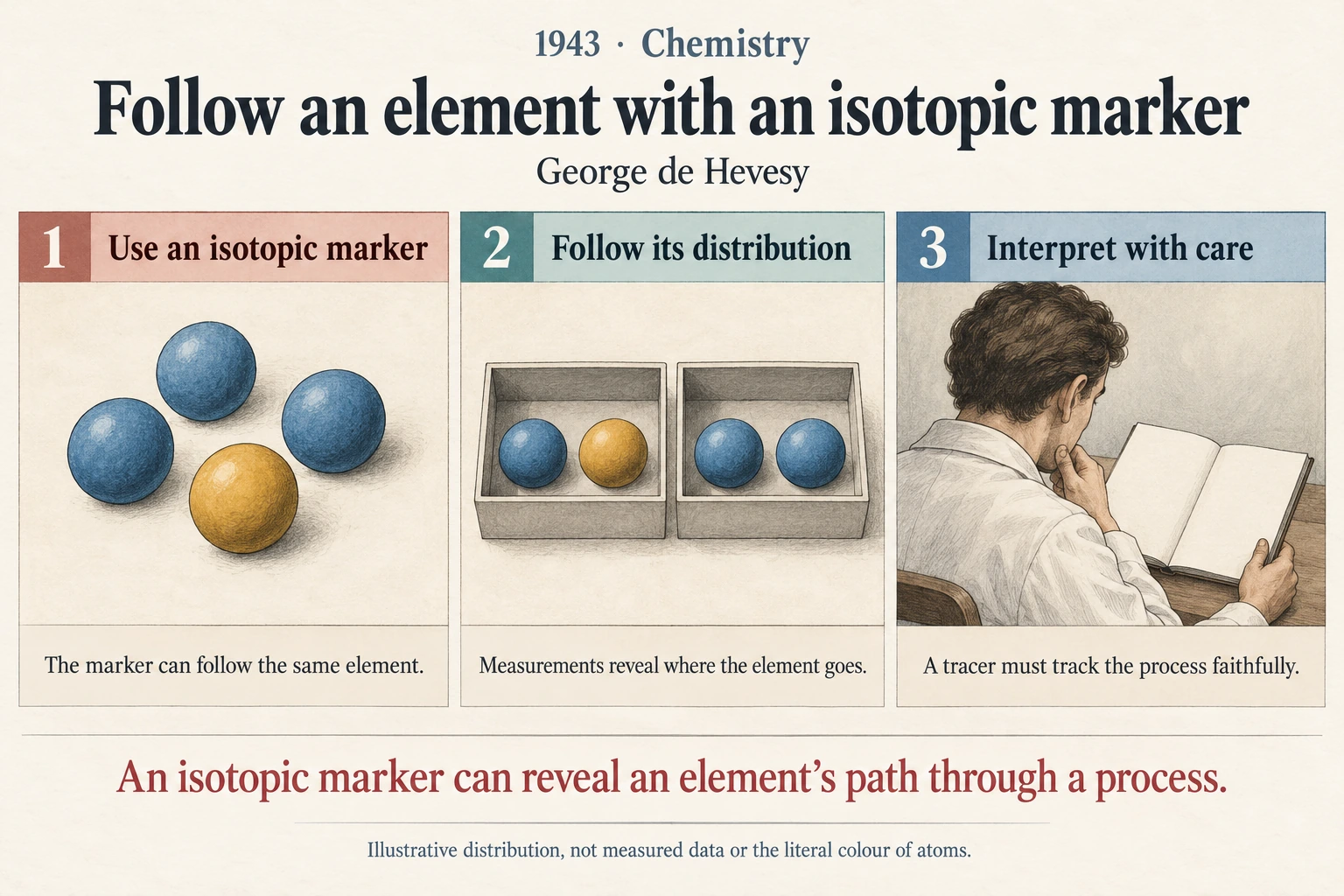
How can researchers follow a small amount of an element when it mixes with a much larger amount of the same element? A difficulty in separation suggested an answer. Radioactive lead and ordinary lead were so similar chemically that attempts to separate them failed. An identifiable isotope could therefore accompany the element through a process instead of being removed from it.
De Hevesy and Paneth used radioactive tracing in 1913, and the method developed across inorganic chemistry and biology. Radiation made a radioactive isotope detectable; the element’s chemistry determined how it moved and exchanged. Later access to more isotopes expanded the range of questions. Stable isotopes could also serve as tracers, detected by different methods. The award recognised this way of investigating processes, rather than the discovery of hafnium or a claim that every tracer must be radioactive.
Why it matters
Tracing made distributions, exchanges and turnover accessible even when direct observation of individual atoms was impossible. It connected chemistry with the study of living systems. A tracer result still needs interpretation: where a marker is detected is evidence about a process, not automatically a complete account of every reaction or biological effect.