c.curionodeThe Nobel Archive

1944 · Peace

Keep humanitarian work open to scrutiny

The Red Cross committee’s wartime assistance mattered, while its failures toward people persecuted by the Nazis remain essential to the history.

Humanitarian workPrisoners of warFamily contactHolocaust history
1944Peace

Visual guide

The prize, pictured

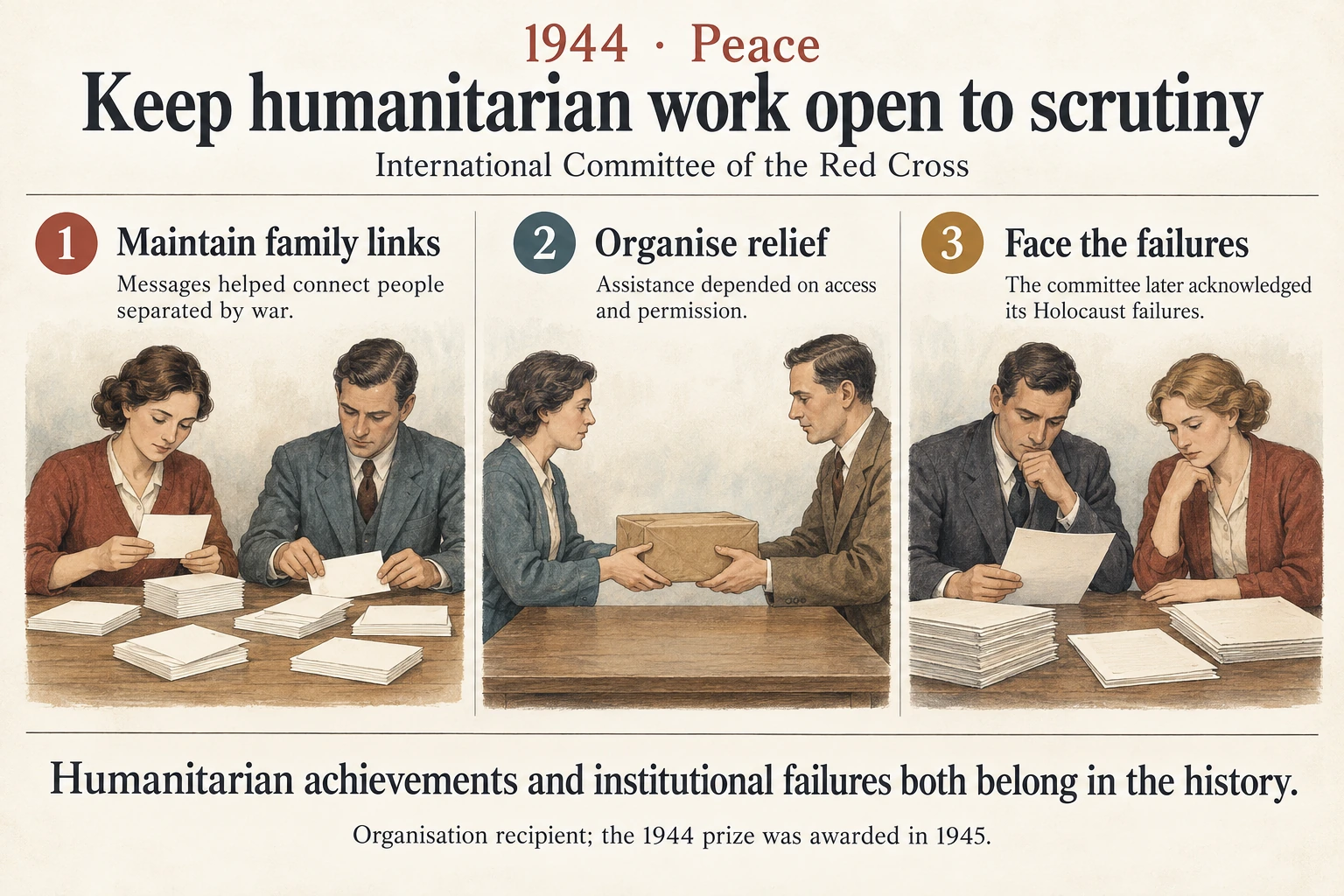
Infographic explaining Keep humanitarian work open to scrutiny
Original AI-generated infographic. A conceptual overview; the explanations and sources below provide context.
Read the poster text

Humanitarian achievements and institutional failures both belong in the history.

  1. Maintain family links

    Messages helped connect people separated by war.

  2. Organise relief

    Assistance depended on access and permission.

  3. Face the failures

    The committee later acknowledged its Holocaust failures.

Organisation recipient; the 1944 prize was awarded in 1945.

01 · The contribution

The idea, in everyday language

War separated prisoners and civilians from their families and exposed people in captivity to severe danger. The International Committee of the Red Cross worked on prisoner-of-war information, family correspondence, relief parcels and attempts to visit people in detention. These activities needed negotiations, permission and practical organisation; the committee’s neutral role did not guarantee access or protection.

The whole 1944 Peace Prize went to this organisation, already a laureate in 1917. Its humanitarian achievements must be considered alongside failure during the Holocaust. In 1942 the committee considered a public appeal but did not issue it. Its later account acknowledges that it failed to protect Jews and other persecuted groups. Individual delegates’ efforts and relief deliveries were real, but did not stop persecution and genocide.

Why it matters

The committee helped sustain humanitarian assistance and family links amid war. Its history also shows why access claims and institutional choices need scrutiny, especially when an organisation faces mass persecution. A peace award cannot serve as a blanket judgment that every decision was adequate or every vulnerable group protected.

02 · The recipients

Who brought the idea to life?

03 · Years in the making

The path here

  1. 1863

    The committee is founded in Geneva.

  2. 1917

    Receives its first Peace Prize.

  3. 1942

    Considers, but does not issue, a public appeal about persecution.

  4. 1944

    The Peace Prize is reserved; wartime access remains limited.

  5. 1945

    The 1944 prize is awarded to the committee, represented at the ceremony.

  6. 1995

    Publicly expresses regret over its failures during the Holocaust.

04 · Read further

From the original sources

Original explanations by Curionode, based on the official records below. Biographical details and affiliations refer to the award year.

  1. Official award summary nobelprize.org
  2. Award ceremony speech nobelprize.org
  3. ICRC historical account: the Second World War and Holocaust icrc.org