c.curionodeThe Nobel Archive

1985 · Economic Sciences

Saving over a lifetime; financing under assumptions

Modigliani linked household resources across time and clarified benchmarks for corporate financial markets.

The Sveriges Riksbank Prize in Economic Sciences in Memory of Alfred Nobel.

life-cycle savingconsumptioncapital structurefinancial markets
1985Economic Sciences

Visual guide

The prize, pictured

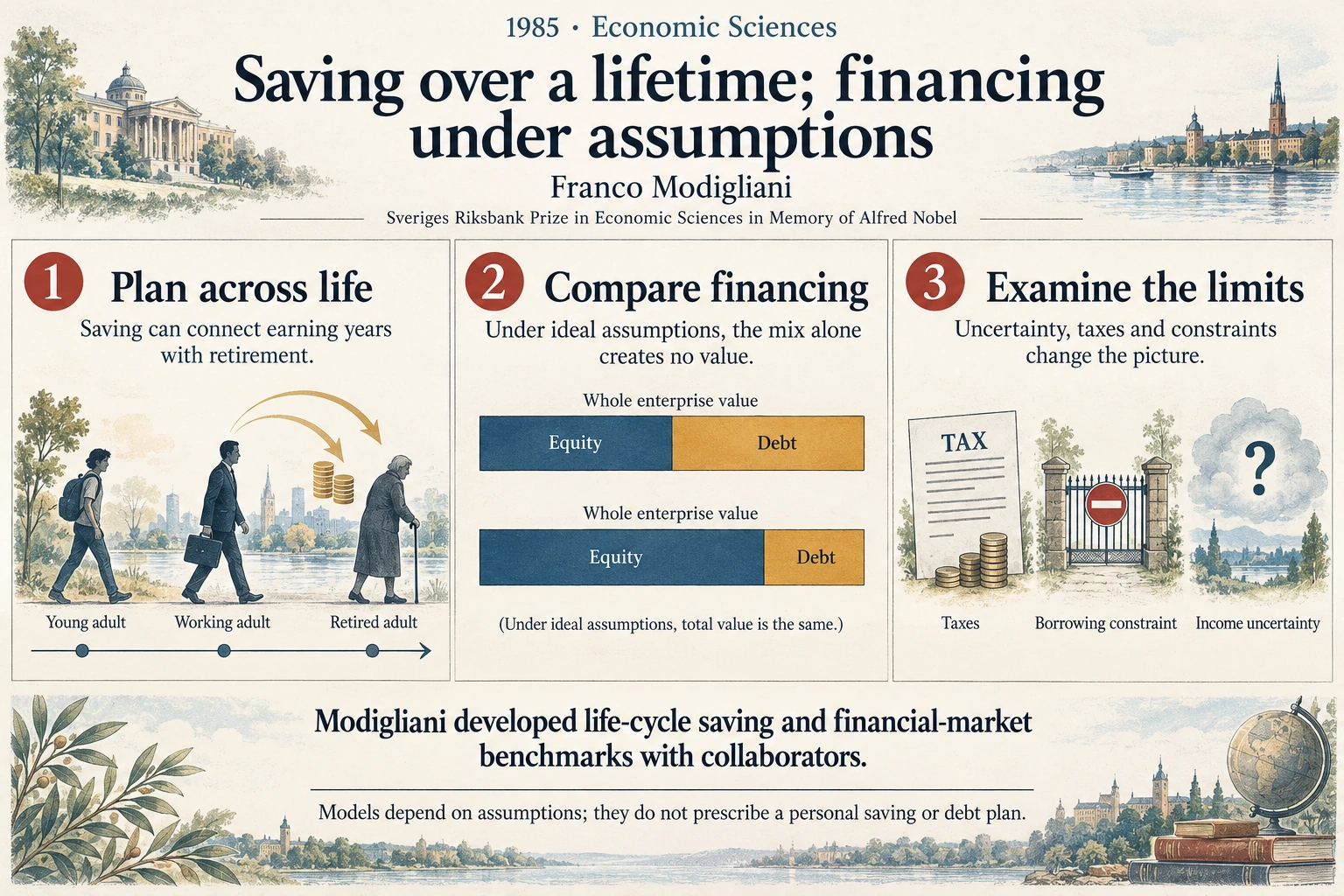
Infographic explaining Saving over a lifetime; financing under assumptions
Original AI-generated infographic. A conceptual overview; the explanations and sources below provide context.
Read the poster text

Modigliani developed life-cycle saving and financial-market benchmarks with collaborators.

  1. Plan across life

    Saving can connect earning years with retirement.

  2. Compare financing

    Under ideal assumptions, the mix alone creates no value.

  3. Examine the limits

    Uncertainty, taxes and constraints change the picture.

Models depend on assumptions; they do not prescribe a personal saving or debt plan.

01 · The discovery

The idea, in everyday language

With Richard Brumberg, Modigliani developed the life-cycle hypothesis: households consider resources over a lifetime when choosing consumption and saving. Saving during earning years can support retirement consumption. The framework connects aggregate saving with income growth and the age structure of a population, while inviting comparison with evidence and alternative motives.

With Merton Miller, he asked whether changing a firm’s mix of debt and equity changes its total value. Their 1958 benchmark holds investment and business risk fixed and assumes ideal capital markets without taxes or other relevant frictions. Under those conditions, changing the financing mix alone does not create value. A separate 1961 analysis considered dividend policy.

Why it matters

The work gave economists tools to study household saving, demographics and retirement, and gave financial economics a baseline for asking why financing matters. Collaborators were central: Brumberg to the life-cycle work and Miller to the finance results. Modigliani alone received this year’s memorial prize.


02 · The people

Who brought the idea to life?

Illustrated portrait of Franco Modigliani

Franco Modigliani

Prize share · 1

Modigliani developed the life-cycle hypothesis of saving with Brumberg and fundamental financial-market results with Miller. The first relates consumption and saving to resources over a lifetime; the second asks whether a firm’s debt–equity mix changes its total value under idealised assumptions. Real constraints and market frictions matter. He received the full Sveriges Riksbank Prize in Economic Sciences in Memory of Alfred Nobel.

Read the biography ↗

03 · Years in the making

The path here

  1. 1944

    Modigliani completes his New School doctorate under Marschak.

  2. 1954

    Life-cycle work with Brumberg is published.

  3. 1958

    Modigliani and Miller publish their capital-structure benchmark.

  4. 1985

    Modigliani receives the full economics memorial prize at MIT.

04 · Read further

From the original sources

Original explanations by Curionode, based on the official records below. Biographical details and affiliations refer to the award year.

  1. Official announcement nobelprize.org
  2. MIT biography of Franco Modigliani news.mit.edu
  3. New School institutional history: Modigliani’s 1944 doctorate (p. 10) histories.newschool.edu

More in Economic Sciences

Browse this subject ↗