01 · The discovery
The idea, in everyday language
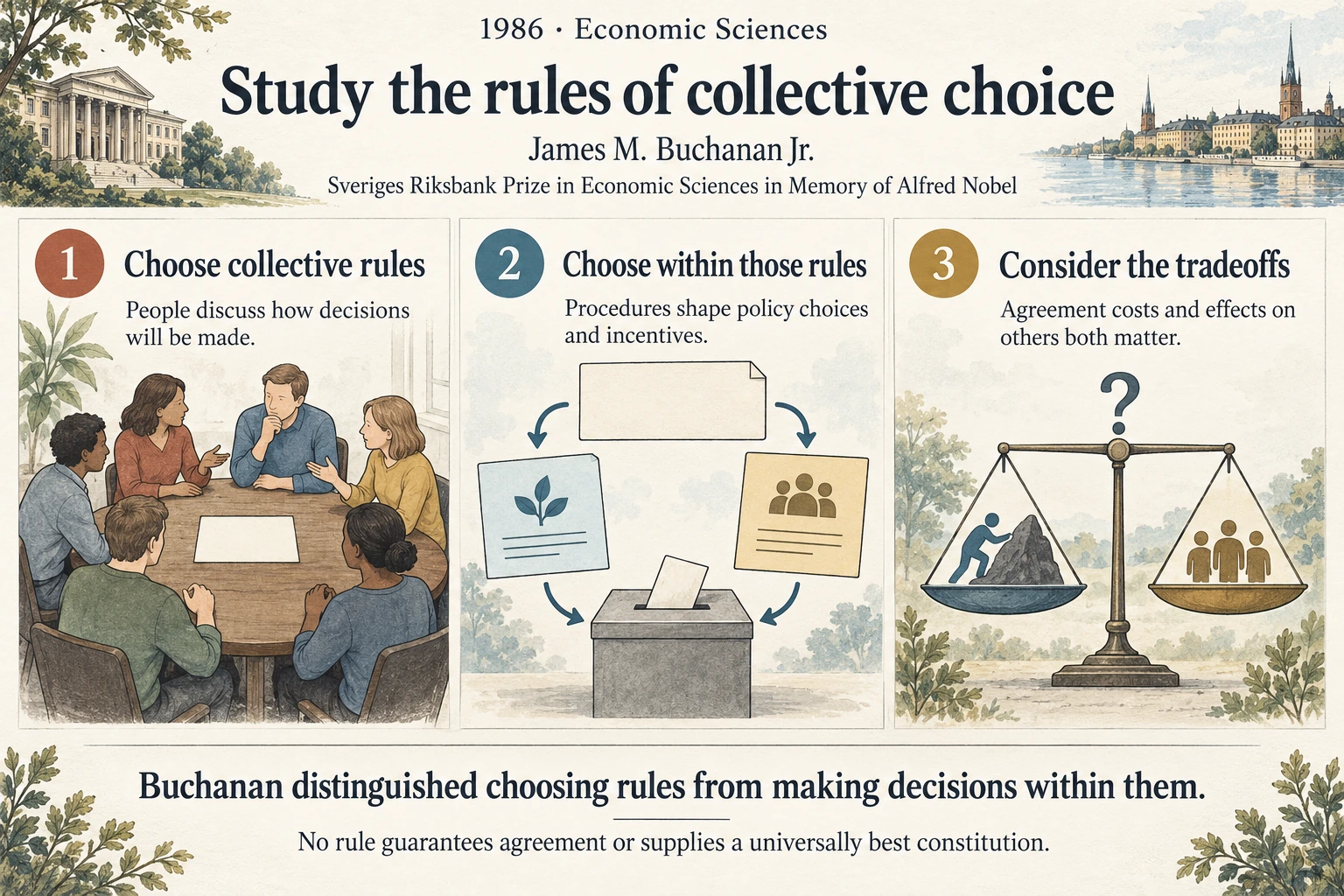
Collective decisions involve people with preferences and incentives: voters, officials and other participants. Buchanan applied economic reasoning to these processes while asking a separate constitutional question: what rules should people agree to use? Choosing a rule differs from choosing a policy after that rule is in place.
The Calculus of Consent, written with Gordon Tullock in 1962, examined agreement, decision costs and costs imposed on others. A demanding agreement rule can limit imposed costs while making decisions harder to reach. Buchanan’s contractual approach considered mutual advantage and the conditions for cooperation, rather than treating government as an actor automatically serving one shared interest.
Why it matters
The work helped establish public choice and constitutional economics, connecting public finance, incentives and collective rules. Collaboration with Tullock and later Geoffrey Brennan extended the approach. Buchanan received the full Sveriges Riksbank Prize in Economic Sciences in Memory of Alfred Nobel for the contractual and constitutional foundations of decision-making.