c.curionodeThe Nobel Archive

1988 · Economic Sciences

Explain when markets allocate efficiently

Allais connected mathematical market analysis with welfare and the use of scarce resources.

The Sveriges Riksbank Prize in Economic Sciences in Memory of Alfred Nobel.

market equilibriumPareto efficiencywelfare economicsresource allocation
1988Economic Sciences

Visual guide

The prize, pictured

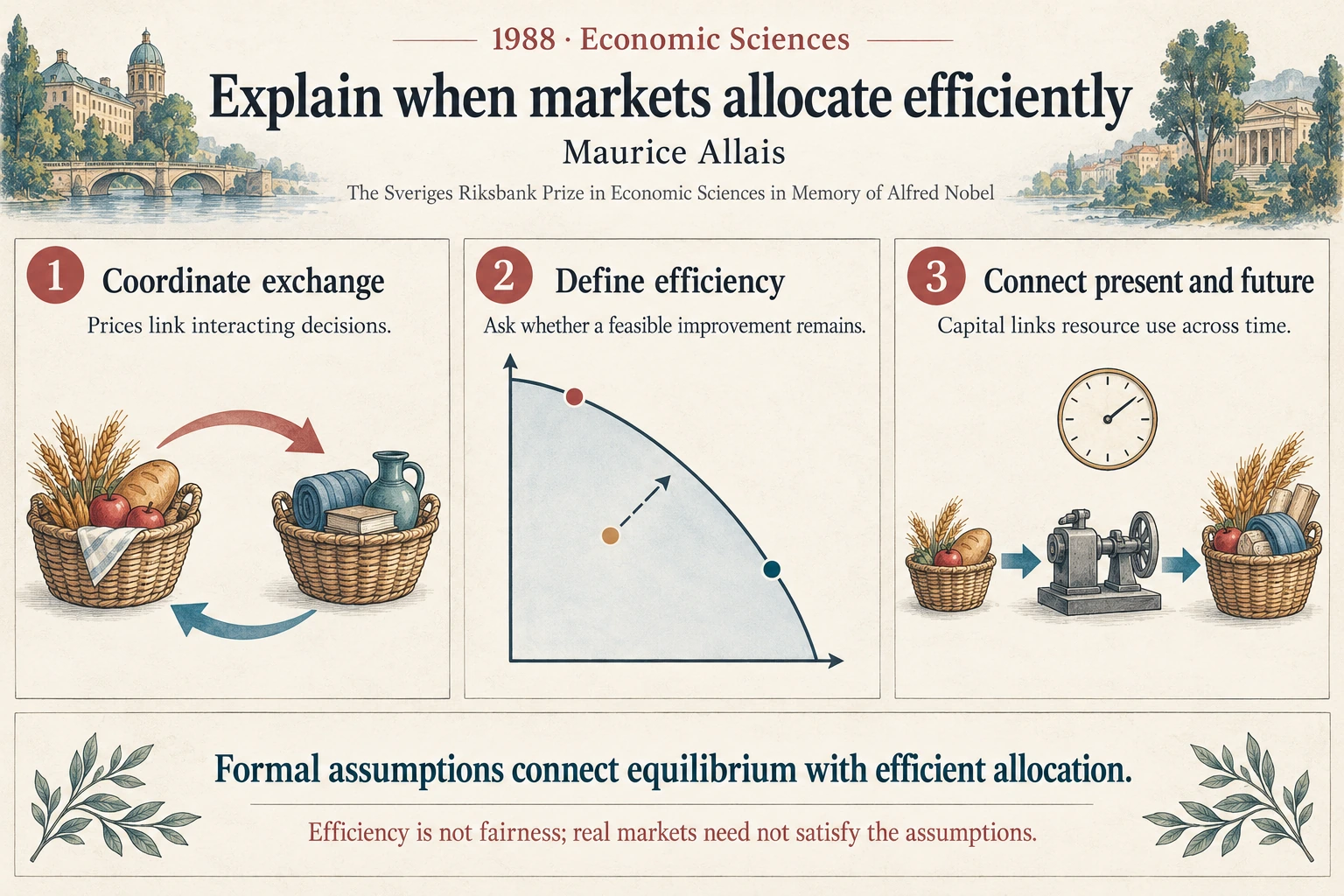
Infographic explaining Explain when markets allocate efficiently
Original AI-generated infographic. A conceptual overview; the explanations and sources below provide context.
Read the poster text

Formal assumptions connect equilibrium with efficient allocation.

  1. Coordinate exchange

    Prices link interacting decisions.

  2. Define efficiency

    Ask whether a feasible improvement remains.

  3. Connect present and future

    Capital links resource use across time.

Efficiency is not fairness; real markets need not satisfy the assumptions.

01 · The discovery

The idea, in everyday language

Resources can be allocated in many ways. Allais analysed how prices, production and consumption interact, and when a market equilibrium can be efficient. Pareto efficiency means that no feasible reallocation can improve someone’s position without worsening someone else’s. It is a criterion about possible improvements, not a definition of justice.

His welfare analysis also considered how efficient allocations relate to competitive markets when their assumptions hold, including changes in initial resource ownership. Intertemporal analysis connects present resources, capital and future use. These formal connections help separate claims about economic efficiency from choices about distribution.

Why it matters

Allais linked mathematical economics with practical questions about pricing and public services, including circumstances with limited competition. He received the full Sveriges Riksbank Prize in Economic Sciences in Memory of Alfred Nobel. His separate work on choices under risk, including the Allais paradox, is not the sole basis of this award.


02 · The people

Who brought the idea to life?

Illustrated portrait of Maurice Allais

Maurice Allais

Prize share · 1

Allais developed mathematical accounts of markets and efficient allocation, connecting equilibrium with welfare under stated conditions. Efficiency means no feasible improvement for someone without a loss for someone else; it does not mean equality or fairness. His work also considered capital over time and pricing where competition is limited. The well-known Allais paradox is a separate contribution to choice under risk, not the sole reason for the award. He received the full memorial prize.

Read the biography ↗

03 · Years in the making

The path here

  1. 1943

    Allais publishes his first major study of economic allocation.

  2. 1944

    He begins teaching economics at the Paris mining school.

  3. 1947

    His work on capital and interest extends intertemporal analysis.

  4. 1988

    Allais receives the full memorial prize for markets and efficient resource use.

04 · Read further

From the original sources

Original explanations by Curionode, based on the official records below. Biographical details and affiliations refer to the award year.

  1. Official announcement nobelprize.org

More in Economic Sciences

Browse this subject ↗